Select a site alphabetically from the choices shown in the box below. Alternatively, browse sculptural examples using the Forward/Back buttons.
Chapters for this volume, along with copies of original in-text images, are available here.


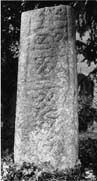
Object type: Lower part of cross-shaft
Measurements: H. (above ground) 102.9 cm (40.5 in); W. 40.7 > 33 cm (16 > 13 in); D. 22.9 > (broken) 21.6 cm (9 > 8.5 in)
Stone type: Coarse-/very coarse-grained, massive yellow sandstone
Plate numbers in printed volume: Pls. 33.170-171, 34.174-175
Corpus volume reference: Vol 1 p. 63
(There may be more views or larger images available for this item. Click on the thumbnail image to view.)
The shaft is surrounded by wide grooved mouldings on all faces.
A (broad): Horizontal flat-band mouldings divide the face into four ornamental panels. (i)–(iii) Free rings linked horizontally by diagonal and surrounding strands. (iv) The same motif but the strands twist and fall into a triangle with pendent loops.
B (narrow): Continuous four-strand plain plait.
C (broad): Panels of grooved interlace – almost indecipherable.
D (narrow): Continuous irregular plait with opposing diagonals and free rings.
This type of shaft, with panels of plait on the broad face and continuous plaits on the narrow, forms the last dregs of the Anglian tradition. The principle of interlace construction is lost.
