Select a site alphabetically from the choices shown in the box below. Alternatively, browse sculptural examples using the Forward/Back buttons.
Chapters for this volume, along with copies of original in-text images, are available here.


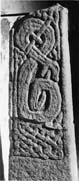
Object type: Part of cross-shaft, in two joining pieces [1]
Measurements: H. 137.5 cm (54.25 in); W. 38 > (break) 31 > 26 cm (15 > 12 > 10.25 in); D. 21 > 18.5 (break) > 14.5 cm (8.25 > 7.25 > 5.75 in)
Stone type: Coarse-grained, massive yellow sandstone
Plate numbers in printed volume: Pls. 62.294-295, 63.296-297, 64.298
Corpus volume reference: Vol 1 p. 82-83
(There may be more views or larger images available for this item. Click on the thumbnail image to view.)
The shaft is edged by a fine roll moulding which ends with the carving about half-way down the block.
A (broad): A ribbon animal with reptilian head has its body crossed in a loop at the top, and its tail coiled round until its tip crosses into its mouth. The body is double-outlined, and pelleted within the looped formation. There is a strange break almost like another head at the bottom of the loop. The creature's body is knotted and crossed by two strands which rise from the ten-strand plain plait below, and link with what is possibly a similar panel above.
B (narrow): A complete panel of changing interlace. The terminals are in six-strand plain plait with median-incised strands; in the centre are four registers of a chainlike pattern which could be thought of as a variation of pattern A (Adcock 1974, 352).
C (broad): A composition of two naked bound men. The upper figure is squatting and holding his out-turned legs. His head is rounded with features lightly incised; his shoulders are exaggeratedly square. On either side of his head is a knot from which fall strands which join a bar-like feature, which penetrates his arms and body. Other knots and strands below his feet enmesh the standing figure below. His figural characteristics are the same as that above, but he is standing and seems to be holding his phallus outlined with a free ring. On either side of his body are simple twists and his out-turned feet are encircled by a large double loop.
D (narrow): A panel of six-strand plain plait with median-incised strands and regular breaks.
This interesting shaft has obvious links with Gainford 2 in the competent regular plaits, and also in the coiled serpent attached by two strands to a panel of plain plait. The bound men in interlace have some affinities with the basket-work men of Cheshire and Staffordshire, but their bodies are complete. The squatting posture is found elsewhere in Scandinavian art, as is the phallic figure. Altogether this shaft, like 2, gives the impression of a new intermingling of Anglian and Scandinavian traditions. The interlace on face D is well cut with fine strands and regular hole points, while on B there is an experimental quality in the change.
