Volume I: County Durham and Northumberland
Select a site alphabetically from the choices shown in the box below. Alternatively, browse sculptural examples using the Forward/Back buttons.
Chapters for this volume, along with copies of original in-text images, are available here.
Current Display: Gainford 07, Durham


Overview
Object type: Part of cross-shaft or impost [1]
Measurements: H. 28 cm (11 in); W. 20.3 cm (8 in); D. 17.8 cm (7 in)
Stone type: Fine-/ medium-grained, massive yellow sandstone
Plate numbers in printed volume: Pl. 64.303-306
Corpus volume reference: Vol 1 p. 83
(There may be more views or larger images available for this item. Click on the thumbnail image to view.)
Present Location
Monks' Dormitory, Durham cathedral, catalogue no. XLIII
Evidence for Discovery
Found in restoration of 1864, possibly in south wall of nave, which was taken down. Kept in Vicarage garden until 1896 when donated to chapter library, Durham
Church Dedication
St Mary
Present Condition
Unworn but broken and recut
Description
A (
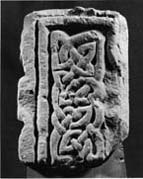
broad): Surrounded by a fine roll moulding, a panel of well modelled changing interlace. On the right side there is also an outer flat-band moulding. The six-cord pattern changes from a bar terminal with U-bend terminals to a pattern F element with U-bend terminals, both turned, and then to alternating half pattern C with outside strands.
B (narrow) and C (broad): Tooled away.
D (narrow): Part of an incised chequer and curvilinear pattern.
Discussion
It is not absolutely certain that face D is recut, but the deeply carved chequers do seem to be secondary, since they cut through the moulding on A. The well modelled strands and the changing patterns, which link both with Tynemouth 5 and Billingham 3, have been compared by Adcock to the work of the carver of the Durham grave-cover (no. 11). Certainly this piece stands apart from the normal run of Anglo-Scandinavian ornament at Gainford.
Date
Tenth to eleventh century
References
Stuart 1867, 64-5, pl. cxiv, 14; Haverfield and Greenwell 1899, no. XLIII, 106 and fig.; Hodges 1905, 230; Cramp 1965a, 7; Adcock 1974, 333-7, pl. 168E
Endnotes
1. The following are general references to the Gainford stones: Greenwell 1880-9b, lxviii; Allen and Browne 1885, 352; (—) 1887-8b, 373. Brock 1888, 176, refers to stones in a graaden (later taken to Durham) and mentions illustrations by STuarts but does not describe them individually. (—) 1905-6b, 343-4, refers to discovery of stones in 1864-5 restoration, and there is also a reference to the finding in 1905 of another stone in the field west of the churchyard wall, and to the discovery of bones and a sword in the churchyard in 1889.