Select a site alphabetically from the choices shown in the box below. Alternatively, browse sculptural examples using the Forward/Back buttons.
Chapters for this volume, along with copies of original in-text images, are available here.


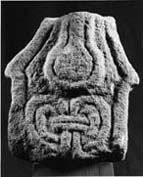
Object type: Part of shaft and head of cross [1]
Measurements: H. 26.6 cm (10.5 in); W. 23.5 cm (9.25 in); D. 13.2 cm (5.25 in)
Stone type: Coarse-grained, massive yellow gritstone
Plate numbers in printed volume: Pl. 67.327-330
Corpus volume reference: Vol 1 p. 85-86
(There may be more views or larger images available for this item. Click on the thumbnail image to view.)
A roll moulding frames the carved faces.
A (broad): In the arm is a double-outlined lorgnette motif in relief; below is part of a vertebral ring-chain pattern with median-incised strands.
B (narrow): Part of a ring-chain with median-incised strands.
C (broad): Broken away.
D (narrow): Part of a vertebral ring-chain with plain strands.
Collingwood commonly assigns the origins of this type of cross with the lorgnette motif to the Ripon school and there is a return fashion which spreads from Cumbria to Yorkshire in the Anglo-Scandinavian period. This is another piece from Gainford which is influenced by the Scandinavian art of the north-west Danelaw, even though a form of the motif is known at a similar date from Bywell (no. 1). The vertebral ring-chain pattern, which can be seen as an influence from the Borre style, is most common in Cumbria, but is found elsewhere among the Anglo-Scandinavian crosses along the Tees (see Croft and Kirklevington, Yorkshire, and Sockburn (nos. 3, 6 and 13): Collingwood 1927, 147-9). This cross, like 2 and 4, contributes to the varied Scandinavian influences at Gainford (Introduction, p. 31).
