Volume I: County Durham and Northumberland
Select a site alphabetically from the choices shown in the box below. Alternatively, browse sculptural examples using the Forward/Back buttons.
Chapters for this volume, along with copies of original in-text images, are available here.
Current Display: Gainford 18, Durham


Overview
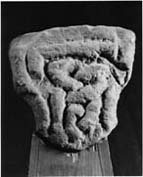
Object type: Cross-arm [1]
Measurements: H. 19 cm (7.5 in); W. 19 cm (7.5 in); D. 11.5 cm (4.5 in)
Stone type: Medium-grained, massive yellow sandstone
Plate numbers in printed volume: Pl. 68.335-338
Corpus volume reference: Vol 1 p. 86
(There may be more views or larger images available for this item. Click on the thumbnail image to view.)
Present Location
Monks' Dormitory, Durham cathedral, catalogue no. XXXIX
Evidence for Discovery
Found in restoration of 1864, possibly in south wall of nave, which was taken down. Kept in Vicarage garden until 1896 when donated to chapter library, Durham
Church Dedication
St Mary
Present Condition
Worn and broken
Description
It is impossible to be certain of the shape of the head. The remaining arm could be type B 11. It is surrounded by a grooved and punch-outlined moulding. The interlace is also in this technique.
A (broad): Muddled interlace with outside strand; possibly a form of pattern D was intended.
B and D (narrow): Uncarved.
C (broad): Irregular interlace, incorporating an asymmetrical loop.
Discussion
As this is carved in a similar technique to 17 and is of the same stone, it could be part of the same monument. The style is crude and inept.
Date
Possibly mid tenth to mid eleventh century
References
Stuart 1867, 64-5, pl. cxiv, 18; Haverfield and Greenwell 1899, no. XXXIX, 103 and fig.; Hodges 1905, 230; Cramp 1965a, 6; Adcock 1974, 319-20, pl. 160A-B
Endnotes
1. The following are general references to the Gainford stones: Greenwell 1880-9b, lxviii; Allen and Browne 1885, 352; (—) 1887-8b, 373. Brock 1888, 176, refers to stones in a graaden (later taken to Durham) and mentions illustrations by STuarts but does not describe them individually. (—) 1905-6b, 343-4, refers to discovery of stones in 1864-5 restoration, and there is also a reference to the finding in 1905 of another stone in the field west of the churchyard wall, and to the discovery of bones and a sword in the churchyard in 1889.