Select a site alphabetically from the choices shown in the box below. Alternatively, browse sculptural examples using the Forward/Back buttons.
Chapters for this volume, along with copies of original in-text images, are available here.


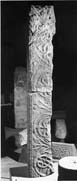
Object type: Incomplete cross-shaft, in three joining pieces [1]
Measurements: H. 179 cm (70.5 in); W. (max.) 29 cm (11.5 in); D. (incomplete) c. 17 cm (6.75 in)
Stone type: Fine-grained, massive yellow sandstone
Plate numbers in printed volume: Pls. 174.922-924, 175.925-927
Corpus volume reference: Vol 1 p. 177-178
(There may be more views or larger images available for this item. Click on the thumbnail image to view.)
Part of two faces of central section survive. The shaft is edged with a cable moulding with a finer inner roll moulding framing eash face.
A (broad): Part of five medallions of an interlaced medallion scroll survive. At each junction the main stem swells into a heavy ridged node and divides into three strands, one of which presumably forms the next medallion, one the stem of the leaf divider, and the third the `filler' of the medallion (see Collingwood's reconstruction: Collingwood 1925, fig. 9). The space between each mcdallion is filled by a pair of large triangular veined leaves with a bud on a stiff stalk dividing them. The upper three medallions appear to contain compositions of rosette berry bunches and short triangular veined leaves on long tangled stems. The surviving element in the fourth volute is a short triangular veined leaf surrounded by tangled stems. In the lower volute the stems form a split knot.
B (narrow) and C (broad): Missing.
D (narrow): Ten volutes of a simple scroll survive. Each volute springs from a ridged node and encircles a rosette or in three instances a rounded berry bunch. From each volute drops a pair of long triangular veined leaves.
This was obviously a large monument, more massive than Hexham 1 or 2, and more deeply cut. The formula with a medallion scroll with ridged nodes on one broad face, and a simple scroll with drop leaves on a curled stem on one narrow face is, however, found on Hexham 2 and at Stamfordham (Introduction, p. 15). The tangled stems which form split knots are most clearly paralleled at Stamfordham. I have elsewhere suggested that this cross could have had the same composition for its missing faces as at Stamfordham (Cramp 1974, 131-2). The deeply cut stylized veins in the leaves remind one of Rothbury, and the combination of rounded and rosette berry bunches is not found on earlier scrolls (Introduction, p. 16).
