Select a site alphabetically from the choices shown in the box below. Alternatively, browse sculptural examples using the Forward/Back buttons.
Chapters for this volume, along with copies of original in-text images, are available here.


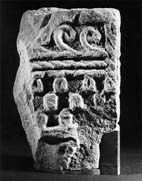
Object type: Part of block impost [1]
Measurements: H. 40 cm (15.75 in); W. 26.5 cm (10.5 in); D. 12 cm (4.75 in)
Stone type: Fine-grained, bedded yellow sandstone
Plate numbers in printed volume: Pl. 184.1003-1006
Corpus volume reference: Vol 1 p. 189
(There may be more views or larger images available for this item. Click on the thumbnail image to view.)
A (broad): The top is surrounded by a wide flat-band moulding, the vertical edge with a cable moulding. The uppermost zone has two complete curlicues and part of a third. These spring from a plain roll moulding, and below is a double cable. The lower zone has three rows of deep counter-sunk chequers.
B (narrow): The uppermost zone has one complete curlicue and part of another springing from a plain roll moulding, then a single cable and two zones of circles divided by plain roll mouldings.
C (broad) and D (narrow): Broken away.
Although there is a possibility that this is a Roman piece (see 31), the idiosyncratic scheme implies that it is Saxon. It is noteworthy that this is the only example in the north of this type of impost, all the rest being of the slab type (e.g. Hexham 28).
