Select a site alphabetically from the choices shown in the box below. Alternatively, browse sculptural examples using the Forward/Back buttons.
Chapters for this volume, along with copies of original in-text images, are available here.


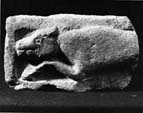
Object type: Animal impost [1]
Measurements: H. 17.8 cm (7 in); W. 31.4 cm (12.4 in); D. 14.2 cm (5.6 in)
Stone type: Coarse-grained, massive deep yellow sandstone
Plate numbers in printed volume: Pl. 185.1012-1015
Corpus volume reference: Vol 1 p. 190
(There may be more views or larger images available for this item. Click on the thumbnail image to view.)
A (long): Part of a running animal enclosed in a flat-band moulding. The head and the front foot of the beast are carved in a high relief. Its snout and ear impinge slightly on the frame and in an attempt to keep the front leg and hoof in the frame, the joint is bent up to touch its lower jaw. The creature has an incised round eye, a pig-like ear and a tusk [2]. There is no carved body patterning on the skin but there are traces of an undercoat for paint (cf. 33 and Monkwearmouth 25).
B (narrow): Broken.
C (long): Uncarved.
D (narrow): Enclosed in a flat-band moulding is a motif carved in high relief in which a circle surrounds a double diamond.
This piece is assigned by Collingwood (1925, 70) to Acca's work. It could just as well belong to Wilfrid's church. It is clearly part of the same composition as 33 and possibly 20 and 35. The stones are almost identical in height, but this piece with two carved faces is most convincingly an impost of an arch which might have, in the manner of carvings at S. Pedro de la Nave, Asturias, lined up with a frieze (Cramp 1974, 119-20). The motif on the end of the impost is a more angular version of similar motifs which are found at Jarrow (no. 24), Ripon, Yorkshire, Simonburn (no. 4), and Ledsham, Yorkshire, as well as in Visigothic Spain (Palol and Hirmer 1967, pl. 17). Such naturalistic smooth-skinned animals may have been paralleled on the original frieze on the west face of Monkwearmouth porch, no. 12 (Introduction, p. 19).
1. The following are general references to the Hexham stones: (—) 1855-7a, 45-6; Rowe 1877, 62-3; Allen 1889, 230; Bailey 1980, 79, 81, 83.
2. This creature was interpreted by Collingwood as a boar, though not Roman (1925, 70). In an earlier work (Cramp 1967a, 22) I wrongly described it as a hound (but see Cramp 1974, 119).
