Select a site alphabetically from the choices shown in the box below. Alternatively, browse sculptural examples using the Forward/Back buttons.
Chapters for this volume, along with copies of original in-text images, are available here.


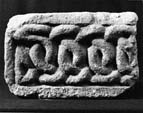
Object type: Impost [1]
Measurements: H. 20.3 cm (8 in); W. 31.1 cm (12.25 in); D. 15.5 cm (6.1 in)
Stone type: Coarse-grained, massive pale yellow sandstone
Plate numbers in printed volume: Pl. 185.1018-1021
Corpus volume reference: Vol 1 p. 191
(There may be more views or larger images available for this item. Click on the thumbnail image to view.)
A (long): A flat-band moulding surrounds a series of diamond-shaped loops twisted together in pairs and interlocked. The terminal is formed by distorting the last link.
B (narrow) and C (long): Broken.
D (narrow): A bar terminal surrounds an unpinned loop.
This interlace with heavy closely packed strands and bar or loop terminals is like imposts 36-7. All bear some resemblance to the octagonal shaft (Jarrow 22) (see Adcock 1974, 142). I have elsewhere considered them to be ninth-century and they seem to belong to the heavy Bernician style (Introduction, p. 17). It is difficult, however, to see where such pieces fit into the architectural history of the site, and like the Jarrow shaft they may be earlier than they appear.
