Select a site alphabetically from the choices shown in the box below. Alternatively, browse sculptural examples using the Forward/Back buttons.
Chapters for this volume, along with copies of original in-text images, are available here.


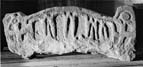
Object type: Grave-cover [1]
Measurements: L. 125.8 cm (50 in); W. 19 cm (7.5 in); D. 51 cm (20.1 in)
Stone type: Coarse-grained, massive yellow sandstone
Plate numbers in printed volume: Pl. 239.1353-1354, 240.1356
Corpus volume reference: Vol 1 p. 242
(There may be more views or larger images available for this item. Click on the thumbnail image to view.)
The shape is reminiscent of a hogback (see below and G.I. p. xxi) and is clearly conceived in architectural terms: the ridge is carved and at each end rectangular raised blocks could represent towers. The ornament is picked back from the surface of the stone. At the crown of the ridge is a circle in a raised surround, and on either side small raised crosses joined to a diamond motif which is attached by triangular roll mouldings to the raised ends.
A (long): At each end is a cross, type A1, set in a circle. The upper arm of the left cross projects above the ring and there is a pellet where it passes the ring. The cross on the right has a large pellet above the ring and the upper arm. Joining the two crosses is a bungled design of eight intersecting arcades. In the centre is a free arch rather like a door.
C (long): A very similar design to that of A save that there are only seven arcades and the central `opening' is double.
Appendix A item (stones dating from Saxo-Norman overlap period or of uncertain date).
The survival of a `hogback' type of monument into the post-Conquest period at Hexham is perhaps explained by the Scandinavian influence in that region, which is reflected in the earlier hogback (no. 18). The intersecting arcades are confidently constructed on a stoup also from this church.
