Select a site alphabetically from the choices shown in the box below. Alternatively, browse sculptural examples using the Forward/Back buttons.
Chapters for this volume, along with copies of original in-text images, are available here.


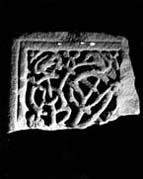
Object type: Upper fragment of cross-shaft
Measurements: H. (max.) 21 cm (8.25 in); W. 28.5 cm (11.25 in); D. (incomplete) 8 cm (3.2 in)
Stone type: Medium-grained yellow sandstone
Plate numbers in printed volume: Pl. 90.478-481
Corpus volume reference: Vol 1 p. 107
(There may be more views or larger images available for this item. Click on the thumbnail image to view.)
Only one face and fragment of another survive.
A (broad): An inhabited scroll framed in a double flat-band moulding. The tangled strands are thick and deeply undercut. The straight crossing strands cross centrally, terminating in small berry bunches; at each corner they cross over or under two small quadrupeds to terminate in leaf-flowers. The two confronted quadrupeds have tails turned over their backs and are in the act of gnawing the plant.
B (narrow) and C (broad): Defaced.
D (narrow): Part of a double roll moulding framing the remains of a plant-scroll: apparently a large veined leaf.
This is an important fragment since it links the motifs and style of the architectural fragments 19 and 20 with cross sculpture. The deep bold carving and the details of the plant-scrolls are identical with those of the friezes, and the composition, with two small squirrel-like creatures, is comparable with Bewcastle, Ruthwell and Edlingham (see Introduction, p. 16). This could have been part of a similarly large cross. Its find-spot near the bridge, when considered in relation to excavated evidence from the site, suggests that it was situated on the eastern perimeter of the monastery, either in the lay burial-ground or at the entrance from the southern overland route.
