Select a site alphabetically from the choices shown in the box below. Alternatively, browse sculptural examples using the Forward/Back buttons.
Chapters for this volume, along with copies of original in-text images, are available here.


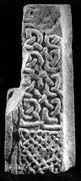
Object type: Incomplete cross-shaft, in two pieces, now reunited
Measurements: H. 81.5 cm (32 in); W. 36.5 cm (14.5 in); D. 13.5 cm (5.5 in)
Stone type: Soft yellow sandstone
Plate numbers in printed volume: Pl. 92.487-490
Corpus volume reference: Vol 1 p. 108
(There may be more views or larger images available for this item. Click on the thumbnail image to view.)
A (broad): Three panels of interlace not divided by a horizontal moulding but enclosed in an outer flat-band and inner roll moulding. (i) Fragmentary. (ii) Four registers of complete pattern A with cross-joined terminals. (iii) A twelve-strand plain plait with capricious breaks.
B (narrow): Redressed.
C (broad): Part of a double flat-band moulding survives on the right edge. (i) A panel of tangled plant-scroll. The details are difficult to determine. The crossing stems are bent at sharp angles. In one angle is a leaf of the large triangular veined type. (ii) A split plait with long central glide.
D (narrow): Recut at top and recut base broken. Part of two panels surrounded by a single flat-band moulding. (i) Almost a whole register of turned complete pattern D with bar terminal. (ii) A six-strand plain plait.
The technique of this shaft is competent but vacillating in style, like that of 3. The strands of the interlace vary between being humped and high modelled. Some of the strands are plain, and some are median-incised. The carver of this interlace and the stems of the plant-scroll can still attempt a genuine over and under technique. The plant leaves obviously relate to earlier Jarrow work, such as 1, but the angular crossings and the thin confused stems are reminiscent of some late Yorkshire scrolls such as Collingham. The interlace patterns and in particular the split plait link these Jarrow shafts (nos. 3 and 4) with work at Chester-le-Street (no. 1) and other co. Durham centres (Introduction, p. 18). The complete pattern D on face D occurs on stones at Lindisfarne (no. 6) and Durham (nos. 1, 5-6), while the plain plait is common in the southern part of co. Durham.
