Select a site alphabetically from the choices shown in the box below. Alternatively, browse sculptural examples using the Forward/Back buttons.
Chapters for this volume, along with copies of original in-text images, are available here.


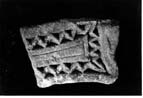
Object type: No. 8, centre of cross-head; no. 9 cross-arm. Possibly two fragments of same head
Measurements:
No. 8: H. 18 cm (7 in); W. 18 cm (7 in); D. Built in.
No. 9: H. 14 < 16 cm (5.5 < 6.3 in); W. 24 cm (9.5 in); D. 11.5 cm (4.5 in)
Stone type: Medium-/coarse-grained yellow sandstone
Plate numbers in printed volume: Fig. 12; Pl. 93.497-499
Corpus volume reference: Vol 1 p. 109
(There may be more views or larger images available for this item. Click on the thumbnail image to view.)
No. 8.
A (broad): A plain central boss is surrounded by deeply cut zig-zag ornament, contained in a flat-band moulding.
No. 9. Possibly the left horizontal arm, since the ornament on the edge would then be seen from below.
A (broad): A simple roll moulding encloses the ornament which spreads out in a wedge shape towards a curving band in the centre (Fig. 12). In the arm a wedge-shaped `plate' with an incised outline is enclosed by zig-zag ornament. B (narrow): Broken off. C (broad): Uncarved. D (narrow) and E (top): Plain. F (bottom): Enclosed within an incised outline is a composition of balusters and plain panels: one baluster; plain panel; three balusters; plain panel to the inner edge.
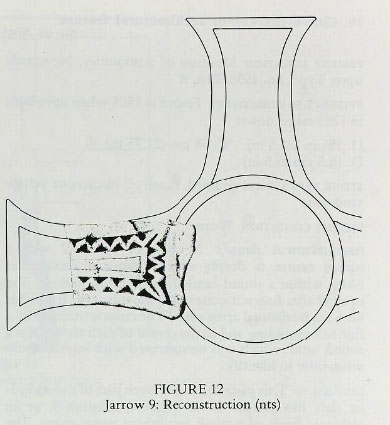
The type of cross-head, B9, like Hexham 1 (Acca's cross) and one from Northallerton, Yorkshire, is plainly copying metalwork models. The similar zig-zag ornament at Northallerton (Collingwood 1919, 373) surrounds a plate-like feature but with a raised central spine and the whole head is more richly decorated. However on the under-side of the arm is an incised design which seems to be reminiscent of the balusters and panels found on imposts at Jarrow. No. 9 is important because it links cross sculpture with the architectural fragments and because it is not carved on the back. It could be that this cross was set inside the church against a wall and represents a stage between the slab-type with a raised cross and the free-standing cross (see also Monkwearmouth 1). The smooth dressing of this stone is comparable with slabs such as 10.
