Select a site alphabetically from the choices shown in the box below. Alternatively, browse sculptural examples using the Forward/Back buttons.
Chapters for this volume, along with copies of original in-text images, are available here.


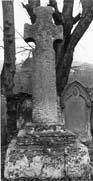
Object type: Complete cross-shaft with head
Measurements:
H. (overall) 175.5 cm (69 in); W. (shaft) 34 cm (13.5 in)
D. (shaft) 24 > 21 cm (9.5 > 8.5 in)
H. (head) 69 cm (27 in); W. (head) 61.5 cm (21.25 in)
Stone type: Coarse-grained, massive yellow sandstone
Plate numbers in printed volume: Pls. 241.1357, 242.1358, 243.1359, 244.1360
Corpus volume reference: Vol 1 p. 243
(There may be more views or larger images available for this item. Click on the thumbnail image to view.)
The shaft and the cross-head are cut from a single block of stone. The head is type A10. There are no edge mouldings on the shaft or head, nor any relief ornament on any face.
A (broad): There are two lightly incised crosses of type A1 at the top and bottom of the shaft.
B and D (narrow) and C (broad): Plain.
Appendix A item (stones dating from Saxo-Norman overlap period or of uncertain date).
Plain crosses such as this with no diagnostic ornament are difficult to date. Similar crosses, although usually with a simpler shape of head, are known from the North York Moors (Woodward 1934), where they seem to be boundary or roadside crosses. However, none of these is dated. The custom of putting crosses as boundary marks is well attested in pre-Conquest times (Introduction, p. 5). The shallow incised ornament is found on crosses in Yorkshire which belong to the Anglo-Norman overlap. (See also Ulgham and Warden 3.)
