Select a site alphabetically from the choices shown in the box below. Alternatively, browse sculptural examples using the Forward/Back buttons.
Chapters for this volume, along with copies of original in-text images, are available here.


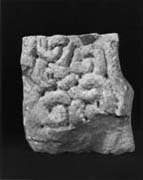
Object type: Fragment of cross-arm [1]
Measurements: H. 24 cm (9.5 in); W. 22.5 cm (8.9 in); D. 14 cm (5.5 in)
Stone type: Medium-grained, massive yellow sandstone
Plate numbers in printed volume: Pl. 194.1082-1085
Corpus volume reference: Vol 1 p. 200
(There may be more views or larger images available for this item. Click on the thumbnail image to view.)
Head, type D9 or D10, and edged by a flat-band moulding.
A (broad): A confused linked pattern with some attempt at under and over technique, but not based on a geometric principle.
B (narrow): Plain.
C (broad): Part of a bungled pattern F design with U-bend terminals.
D (narrow): Broken off.
The confusion of design on these faces and the poor technique probably place this stone late in the series. Adcock (1974, 286) compares it with Abercorn and more remotely with Norham. Certainly it has some links with the northern Bernician schools of the ninth century, but could be a generation or so later.
