Select a site alphabetically from the choices shown in the box below. Alternatively, browse sculptural examples using the Forward/Back buttons.
Chapters for this volume, along with copies of original in-text images, are available here.


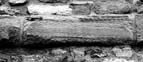
Object type: String-course
Measurements: Stones a and b: Measurements unobtainable; Stone c: H. 24 cm (9.5 in); W. 129.5 cm (51 in); Stone D. 23.5 cm (9.25 in)
Stone type: (c) Medium-grained, massive yellow sandstone
Plate numbers in printed volume: Pl. 117.621-625
Corpus volume reference: Vol 1 p. 127-128
(There may be more views or larger images available for this item. Click on the thumbnail image to view.)
Of c A (long): The remains of four panels subdivided by double cable mouldings can be dimly discerned. Starting from the left: (i) Two creatures(?) (ii) Two figures(?) (iii) A single running animal. (iv) Two possible forms.
Gibb's drawing in Stuart (1867, pl. cxv) seems to receive little support from the present appearance of the string-course, but it is clear that at the time of the church's restoration, after the opening out of the porch in 1866, it was already much decayed. A drawing of the face of the tower before restoration ((—) 1862-8c, fig. 1) shows it cut through by the enlarged window centrally placed in the west front, but it is clearly panelled. The more careful drawing of the detail by Lambert (ibid., fig. 4) shows four panels with animals, or animals and horses. Only the running animal on panel iii is now clear; strangely Lambert does not show the double cable moulding behind it nor the shadow of an upright figure, although such exist. The nearest parallels to these panels in Anglo-Saxon England are the animal friezes and imposts at Hexham. It is possible that such panels had their origins in Gaulish architecture, as for example the animals found on a terracotta brick from Nantes (Hubert, Porcher and Volbach 1969, pl. 59).
