Select a site alphabetically from the choices shown in the box below. Alternatively, browse sculptural examples using the Forward/Back buttons.
Chapters for this volume, along with copies of original in-text images, are available here.


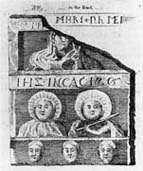
Object type: Part of cross-shaft(?)
Measurements: Unknown
Stone type: Unknown
Plate numbers in printed volume: Pl. 206.1188
Corpus volume reference: Vol 1 p. 211-212
(There may be more views or larger images available for this item. Click on the thumbnail image to view.)
The only basis for a description of this fragment is Hutchinson's illustration, which appears to depict the broad face of a cross-shaft. It was surrounded by a wide flat-band moulding and divided into three panels. The upper two dividing bands seem to have been incised with capitals but the third thin band seems to have been plain. The upper broad bands seem to have been inscribed in Latin with Anglo-Saxon capitals, reading:
(a) Upper:
I[H] —
The `H' could also be seen as part of an `M' (see below).
(b) Lower:
IHS·INCACI[SO] —
(c) The engraving also records an inscription on the back, apparently in Anglo-Saxon capitals and runes:
mHRI+NH MEI —
There are three figural panels: (i) A hooded or draped bust (?). (ii) Two figures with haloes, the one on the right holding a wand or staff in his left hand. (iii) Three heads.
The inscription was read as IM— IHS NAZARAIOS by Raine (1852, 259) and this interpretation has been accepted by Okasha (1971, 103). Hutchinson's drawing indicates an inscription apparently with a runic `m' on the back of the fragment. Page believes that this is most likely a weathered Roman `M' but draws attention to the occasional mixed inscription from the north-east, e.g. at Alnmouth and Chester-le-Street (Page 1969, 47-8). The figures' round faces and prominent haloes could be like those on Norham 4, but no other surviving shaft at Norham has provision for inscribed panels. It is possible that the figures were more like those at Bedlington, but no stylistic judgement can be based on Hutchinson's drawing.
