Select a site alphabetically from the choices shown in the box below. Alternatively, browse sculptural examples using the Forward/Back buttons.
Chapters for this volume, along with copies of original in-text images, are available here.


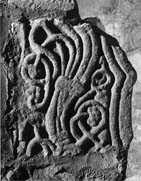
Object type: Incomplete cross-arm
Measurements: H. 31.7 cm (12.5 in); W. 26 cm (10.25 in); D. 21.5 cm (8.5 in)
Stone type: Coarse-grained, massive yellow sandstone
Plate numbers in printed volume: Pl. 206.1178-1179
Corpus volume reference: Vol 1 p. 212
(There may be more views or larger images available for this item. Click on the thumbnail image to view.)
Possibly part of the cross-head for shaft 4, with fine double roll mouldings. Arm, type D9.
A (broad): A tangled scroll springs from a trumpet-like node which has triple bindings and an incised triangular centre. Five strands spring from the top and terminate in short triangular leaves and fan-shaped berry bunches.
B (narrow): (i) The upper curve of the arm has a sunken panel surrounded by a triple roll moulding. (ii) Enclosed by a single roll moulding a panel of closed circuit interlace with pairs of free rings through which pass double diagonal strands with U-bend terminals, and a single circuiting strand.
The dimensions of this cross are larger than any of the shaft fragments. Nevertheless, if no. 1 widened markedly from the surviving base section, it might possibly fit it. A similar `trumpet' scroll is found on shaft 4, but the style and plant details are not the same. The style of cutting, which is deep and confident, and the plant form is much more like 1. Tangled plant-scrolls are a feature of ninth-century work (see no. 1), and large heads with such scrolls are known from Lastingham and Masham in Yorkshire. If this is a horizontal or lower vertical arm, then the interlace would be seen from below. Its eclectic pattern is perhaps best seen as a closed circuit version of that on 11, and may well have derived from it. It is also closely related to 12. The strands of this interlace are fine and in a good over and under technique. Nevertheless these are closed circuit elements and this seems to be the earliest occurrence of the device in sculpture in this area (Adcock 1974, 190-1).
