Select a site alphabetically from the choices shown in the box below. Alternatively, browse sculptural examples using the Forward/Back buttons.
Chapters for this volume, along with copies of original in-text images, are available here.


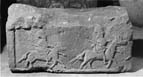
Object type: Hogback [1]
Measurements: L. 61 cm (24 in); W. 25.5 < 30.5 cm (10 < 12 in); D. 33 cm (13 in)
Stone type: Medium-grained yellow sandstone
Plate numbers in printed volume: Pl. 139.745-756
Corpus volume reference: Vol 1 p. 140-141
(There may be more views or larger images available for this item. Click on the thumbnail image to view.)
Type g, illustrative.
A (long): Traces of the roof regulations (type 9) survive at the top. On the left is a broad grooved moulding, and below a narrower grooved moulding with a more rounded section. These enclose a smoothly dressed panel, in which two horsemen canter to the right. The riders hold what seem to be a snaffle and bit with short reins in their left hands and a spear in their right. The spears pass at an impossible angle behind the horses' necks. The horsemen are without helmets but may wear close-fitting caps; they sit on high-backed saddles, and the one on the left is braced back against it. The horses, which are shown in lively motion, have long muzzles, pricked ears, and round eyes. Their long tails are knotted.
C (long): Nothing remains of the enclosing mouldings and the whole face is very worn. It is entirely filled with an ingenious composition of an upper and lower row of free rings, intersected by widely spaced long diagonals which enclose the rings in a series of scallops. The spaces between the knots are filled by rows of pellets.
The bold lively formulae for both faces of this monument set it aside from other such recumbent monuments as a truly creative carving. The spearmen on horseback are related to Hart 1 and Gainford 4 in iconography but not in style of carving. The freedom provided by the wide spaces has been splendidly exploited. On face C the widely spaced strands and knots are unusual in Anglo-Scandinavian art. It seems that the artist was copying late Anglian interlaces.
