Select a site alphabetically from the choices shown in the box below. Alternatively, browse sculptural examples using the Forward/Back buttons.
Chapters for this volume, along with copies of original in-text images, are available here.


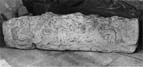
Object type: Hogback [1]
Measurements: L. 112.2 cm (66 in); W. (centre) 24 cm (9.5 in), (end) 17.75 cm (7 in); D. (centre) 45.7 cm (18 in), (end) 33 cm (13 in)
Stone type: Medium-grained yellow sandstone
Plate numbers in printed volume: Pl. 146.767-768
Corpus volume reference: Vol 1 p. 143-144
(There may be more views or larger images available for this item. Click on the thumbnail image to view.)
Type g, illustrative. There seem to be end beasts whose heads are missing; they are depicted with fore and hind feet extended almost at right angles. The figural scenes spread in between these feet.
A (long): The scene is dominated by a man who stands slightly left of centre. His arms are extended but not parallel; his right hand is in the mouth of a beast, his left below the jaws of another beast. He is bare-headed and without any details of armour or clothing. His head is wedge-shaped with round eyes and his nose and mouth lightly conveyed. On his far left is a backward-looking quadruped with one front foot raised and the other tucked back under its body; its two back legs are stiffly extended. It has pointed jaws, ear extensions which loop round its front foot and what seems to be a tongue extension. At its back is another quadruped which faces the man. One of its front feet is raised, the other appears to be bound in a chain-like feature which also rises up to touch the right side of the man. This `chain' may be a continuation of the tail of the animal which loops back and behind its body. The animal has pointed open jaws with a prominent fang and pointed oval eyes. On the right are two very similar creatures. The one nearest to the man also possibly has its feet bound by a chain-like feature, but the backward-looking beast behind does not seem to have ear or tongue extensions.
C (long): In the centre is a frontal human figure with arms outstretched. To left and right of him are three animals. On the extreme left is a quadruped facing left, possibly backward-looking. Its front leg is slightly raised; its back leg is bent under its body, and its legs and body are encircled by a chain-like feature. Back to back with it is another quadruped whose front and back legs are bound. Its gaping jaws seem to meet the right hand of the man, but his hand is not in its mouth. Under his outstretched right arm is a small backward-looking animal. The man himself either holds a dagger, or is gripping the chain-like feature which encircles the front and back legs of the quadruped facing him on the right. This passes through the legs of a backward-looking animal (behind it), whose tongue and ear extensions join. A tiny backward-looking animal is tucked in between the extended legs of the end beast.
The narrative scenes on this hogback set it apart from the other Sockburn pieces. The scheme invites comparison with western hogbacks, such as Heysham, Lancashire, Lowther, Westmorland, Penrith, Cumberland, and the narrative scenes on the Gosforth cross, Cumberland (Collingwood 1927, figs. 207, 210-11, 184), and more remotely with the Gotlandic picture-stones. The iconography of this stone has received the most attention, but the various style elements may be considered first. Animals with tongue, tail or ear extensions which bind their feet can be found in late ninth- to early tenth-century contexts in Mercia and Northumbria, with a clear derivation from ninth-century Mercian types (Cramp 1977, figs. 62-3). However, the beast with fangs and pointed jaws, as here, is clearly influenced by Scandinavian art (Introduction, p. 29). The slim backward-looking beasts can be paralleled in Anglo-Scandinavian art in Cumbria but they are also found on Gotlandic stones, such as Buttle Änge. Moreover, the way in which the foot of an animal shown in movement is bent back parallel to its body is also found on the Gotlandic stones. The treatment of the human face and figure can be paralleled on Anglo-Scandinavian stones such as Gosforth, Heysham, or Gainford 5. It therefore seems reasonable to consider this as a piece strongly influenced by Scandinavian traditions.
It seems sensible to see such elaborate `narrative' depictions as advancing either sequentially or allegorically. On side A the scene could be Týr putting his hand into the mouth of the wolf Fenrir, and on his other side the hound Garm who will eventually kill Týr on the day of Ragnarök. The other animals would then be the beasts who 'join with the wolf' as Lang (1972, 238-40) interprets this scene. However, it seems unreasonable to suppose that side C represents the same scenes. If we put Týr giving his hand on one side, and Týr fighting Garm on the day of Ragnarök on the other, then on side A the other animals are superfluous. The man on side C with arms outstretched horizontally seems to be holding animals at bay. The theme of the Lord of the animals runs through many cultures (Salin 1952, 259-340), and one could have a theoretic contrast here, as on the Gosforth cross (Berg 1958; Bailey and Lang 1975). Knowles (1896-1905b, 116) considered that the stone showed Daniel in the lions' den. Certainly Daniel and the lions can take many strange attitudes and Daniel can be shown with hands upraised in the orans position. However, on side C the figure has his arms extended in the position of Crucifixion. Possibly we have here another example of the re-interpretation of Germanic legend in Christian terms. In this case both sides of the hogback depict Salvation scenes.
