Select a site alphabetically from the choices shown in the box below. Alternatively, browse sculptural examples using the Forward/Back buttons.
Chapters for this volume, along with copies of original in-text images, are available here.


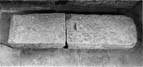
Object type: Grave-cover, in two joining pieces [1]
Measurements: L. 134.75 cm (53.5 in); W. 35.5 > 32.5 cm (14 > 12.75 in); D. 16.5 cm (6.5 in)
Stone type: Medium-grained yellow sandstone
Plate numbers in printed volume: Pls. 153.798-799, 154.801
Corpus volume reference: Vol 1 p. 154
(There may be more views or larger images available for this item. Click on the thumbnail image to view.)
The slab is edged with a flat, grooved moulding.
A (broad): Divided by a double-ended cross, type A1, which is outlined with a fine roll moulding. The space between the double ends is filled with two panels of free rings, in which the rings are crossed by two diagonal strands.
B and D (narrow): Filled by a zig-zag pattern.
C (broad): Uncarved.
Appendix A item (stones dating from Saxo-Norman overlap period or of uncertain date).
This type of large-scale slab or grave-cover was first introduced late in the pre-Conquest period, and continues after the middle of the eleventh century (Introduction, p. 9).
