Select a site alphabetically from the choices shown in the box below. Alternatively, browse sculptural examples using the Forward/Back buttons.
Chapters for this volume, along with copies of original in-text images, are available here.


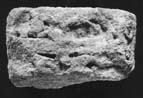
Object type: Part of a carved grave-cover
Measurements: L. 26.5 cm (10.4 in); W. 42.1 cm (16.5 in); D. 16.3 cm (6.4 in)
Stone type: Pale orange (10YR 8/4), sparry matrix supported, shelly, peloidal oolite. Oolith commonly hollow 0.2 to 0.6 mm. Peloids around 2 mm and shell debris 5–10 mm. Possibly Taynton Limestone Formation, Great Oolite Group, Middle Jurassic.
Plate numbers in printed volume: Ills. 301-303; Fig. 30D
Corpus volume reference: Vol 10 p. 213-4
(There may be more views or larger images available for this item. Click on the thumbnail image to view.)
This fragment, although now in a very battered state, was once part of a decorated grave-cover with chamfered edge faces.
A (broad): The main face is divided into at least two zones by a horizontal border, and separated from the chamfered sections by a median-incised fillet. The upper panel contains the base of what may be a 'bush' scroll with opposed, curving, knotted branches and, to the left of the central stem, one tightly curved leaf terminal. The lower panel contains an opposed pair of leaf-flowers now no more than 'outline' shapes due to the damaged state of the carved surface.
B (narrow): The chamfered side face is carved with a running, plain-stem scroll which contains very regular circular berry clusters or rosettes.
The opposed pair of leaf-flowers in the lower panel, although only surviving in 'outline', are very similar to the leaf-flowers on the face of Gloucester St Oswald 5. The berry clusters on the chamfered face are similar to those found within the volute of a running scroll on the border of the frontispiece to Bede's Lives of St Cuthbert which is dated to c. 934 (Cambridge, Corpus Christi MS 183, fol. 1b: Backhouse et al. 1984, 26–7, ill. 6). Indeed the border of this folio, which is in effect the painted equivalent of a chamfer, contains all the elements used on this stone. West has noted this illustration as a parallel for Gloucester St Oswald 5 and 6 (West 1983, 49–50) and it seems reasonable to suggest that St Oswald 7 is broadly contemporary.
