Select a site alphabetically from the choices shown in the box below. Alternatively, browse sculptural examples using the Forward/Back buttons.
Chapters for this volume, along with copies of original in-text images, are available here.


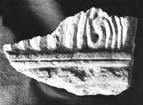
Object type: Decorative impost or frieze fragment
Measurements: H. 8.9 cm (3.5 in); W. 14.6 cm (5.7 in); D. 5.7 cm (2.2 in)
Stone type: Greyish orange (10YR 7/4) clast supported oolitic shelly limestone with sparry matrix and sparse hollow ooliths ranging from 0.2 to 1 mm in size. Shell debris mainly of bivalves and some gastropods up to 5 mm. Possibly Taynton Limestone Formation, Great Oolite Group, Middle Jurassic.
Plate numbers in printed volume: Ills. 313-4; Fig. 18E
Corpus volume reference: Vol 10 p. 216
(There may be more views or larger images available for this item. Click on the thumbnail image to view.)
Fragment of stiff-leafed acanthus palmette.
This and a second, similar fragment (Gloucester St Oswald 14), were probably part of a frieze or decorative imposts or capitals within the church. Parallels for the stiff-leafed acanthus can be found in many late tenth-/early eleventh-century manuscripts: for example, the Salisbury Psalter, dated to 969–78 (Salisbury, Cathedral Lib. MS 150: Temple 1976, 45–6, cat. 18, ill. 57), or the late tenth-century Ramsey Psalter (BL, Harley MS 2904: Backhouse et al. 1984, 60, cat. 41, col. pl. IX). In stone, St Oswald 13 and 14 are very close in style to a tenth-century impost fragment from Avebury, Wiltshire (Cramp 2006, 201, ill. 396) and to an impost fragment from Peterborough Cathedral (West 1993, 254, fig. 6). They are also similar to the foliate decoration on the belfry openings at Langford in Oxfordshire where the tower has been dated, on architectural grounds, to the mid eleventh century (Tweddle et al. 1995, 215, ills. 297–312). At St Oswald's the Period II phase (first half of the tenth century), which included the construction of a new chancel wall and Building A (the separate eastern crypt), would offer an appropriate context for these pieces.
