Select a site alphabetically from the choices shown in the box below. Alternatively, browse sculptural examples using the Forward/Back buttons.
Chapters for this volume, along with copies of original in-text images, are available here.


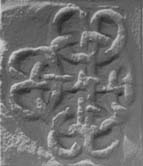
Object type: Small carved panel
Measurements: H. 23 cm (9 in); W. (of carved face) 18.5 cm (7.3 in); D. (of the block on which the design is carved) c.20.5 cm (8 in)
Stone type: Thick covering of modern emulsion paint makes detailed identification impossible. It is just possible to see that it is a poorly sorted, shelly oolite. ?Inferior Oolite Group, Jurassic.
Plate numbers in printed volume: Ill. 477
Corpus volume reference: Vol 10 p. 262-3
(There may be more views or larger images available for this item. Click on the thumbnail image to view.)
Discovered during the enlargement of the nave in 1851–2 'near the base of the present central pier' (Royce 1882–3, 50).
The carving is on one end of a stone that forms part of the splayed eastern jamb of the window, and consists of paired interlace strands that cross each other at the centre and end in four double loops that are woven around an encircling ring. In the Grammar of Ornament this is called a 'return-loop pattern' (see Cramp 1991, xxxii, no. 3, fig. 25, Bv and Bvii; and compare fig. 25, Aii). The carving is trimmed off on the right-hand (east) side. The face of the carving is flush with the stone. Around the design a roughly circular area has been carved away to give a recessed background that has a dish-like profile 1 cm (0.4 in) deep at the centre and sloping up to the face of the stone at the edges of circle.
Appendix A item (stones dating from Saxo-Norman overlap period or of uncertain date).
Encircled patterns are a widespread design motifs in Anglo-Saxon carving, used over several centuries. An impost carved with three linked encircled designs and dated to the eighth/ninth century comes from Kirby Hill in northern Yorkshire (Lang 2001, 134–5, fig. 16, ills. 369–70). Ninth-/tenth-century examples can be found at Glastonbury, Somerset, and Ramsbury, Wiltshire (Cramp 2006, 153–4, 228–30, ills. 224, 232, 490, 498–502), St Mary Castlegate, York (Lang 1991, 99, ills. 313, 316), Chester-le-Street and Hart, Co. Durham (Cramp 1984, 53–4, 93, 103, pls. 20.102, 79.398). Tenth-century examples come from Chester-le-Street, Co. Durham and Norham, Northumberland (Cramp 1984, 58, 210–11, pls. 26.140, 27.143, 205.1169), from Barking, Essex (Tweddle et al. 1995, 205, ill. 256), and from Gloucester (this volume Gloucester London Road 1, p. 221, Ill. 356). And there are tenth- to eleventh-century examples from Jarrow, Co. Durham (Cramp 1984, 108–9, pl. 93.496), Sonning and Wantage, both Berkshire, and Wherwell, Hampshire (Tweddle et al. 1995, 263–4, 268, 270–1, fig. 37, ills. 454, 474–5, 479–80). Indeed, one is even used as the motif for the Corpus. However, none has the double-strand and double-loops of the Lower Swell carving. In this respect the Lower Swell carving most closely resembles one of the motifs on a gravestone or tomb fragment from Bisley dated to the first half of the eleventh century (this volume Bisley Parish 2, p. 256, Ill. 453). But more geometrical versions of the Lower Swell pattern, used in square panels, can be found on Aycliffe 1, Chester-le-Street 1 and Durham 11, all in Co. Durham (Cramp 1984, pls. 7.26, 20.102, 49.235).
The block of the stone, on the end of which the encircled design is carved, has been cut back obliquely on its west face to form part of the splayed window jamb. It has also been trimmed down on its eastern side, removing part of the design. The block is, therefore, now roughly square, but originally it was probably wider than it is high, with the carving presumably in the centre of the carved face. This, and its comparatively shallow depth, suggests that the Lower Swell stone might originally have been used as part of a piece of church furniture, or perhaps as an architectural element. A date in the eleventh century is most likely.
