Select a site alphabetically from the choices shown in the box below. Alternatively, browse sculptural examples using the Forward/Back buttons.
Chapters for this volume, along with copies of original in-text images, are available here.


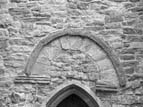
Object type: Imposts
Measurements:
2a (eastern impost): H. 15.5 > 15 cm (6.1 > 5.9 in); W. 57 cm (22.4 in); D. 3.5 cm (1.4 in) visible
2b (western impost): H. 18 > 11 cm (7.1 > 4.3 in); W. (max.) 33 cm (13 in); D. 9.5 cm (3.7 in) visible.
Hood-moulding: 9 cm (3.5 in) wide.
Stone type: Limestone, very shelly, sparry matrix supported, oolitic with all the ooliths being hollow. Shell debris mainly around 5 mm in size but some fairly complete shells up to 3cm. The shell content seems to be mainly oyster. Ooliths 0.35 to 0.7 mm in size. The colour ranges from greyish orange to dark yellowish orange (10YR 7/4 to 10YR 6/6). The bedding is parallel to the horizontal imposts. The stones used for the hood-moulding and voussoirs of the arch above is similar to the imposts. Possibly from low in the Cleeve Cloud Member, Birdlip Limestone Formation, Inferior Oolite Group, Middle Jurassic.
Plate numbers in printed volume: Ills. 389-91; Fig. 22L
Corpus volume reference: Vol 10 p. 231-2
(There may be more views or larger images available for this item. Click on the thumbnail image to view.)
The east and west imposts, voussoirs and hood-moulding of the Anglo-Saxon north doorway. Both imposts carry triple horizontal half-round mouldings, above a concave chamfer c. 6 cm (2.4 in) deep. The western impost is burnt and tapers from east to west. The voussoirs are laid 'with more than customary disregard for radial joints', with a particularly sharply wedge-shaped voussoir being required just above the eastern springer in order to complete the arch (Taylor and Taylor 1965, i, 430–1). The hood-moulding is flat-faced and roughly semi-circular. The original opening below the arch, now infilled, is slightly stilted.
This fine, if somewhat rustic, doorhead and its partner on the south side of the nave (Miserden 1) are, together with the western quoins of the nave, the most obvious reminders of the late Anglo-Saxon fabric in this church. The triple mouldings on the imposts are similar to the tenth-century abaci from Gloucester St Oswald 19–22 (Ills. 330–45), but they are not so carefully carved. They are also similar to the imposts on an eleventh-century doorway from Corhampton (Hampshire) and to the banding on the capital of a small column from Winchester, possibly of mid to late eleventh-century date (Tweddle et al. 1995, 258, 339–40, ills. 442–3, 445, 720–1). An eleventh-century date is most likely, although stone parish churches of significantly greater accomplishment were being built in the county by this date.
