Select a site alphabetically from the choices shown in the box below. Alternatively, browse sculptural examples using the Forward/Back buttons.
Chapters for this volume, along with copies of original in-text images, are available here.


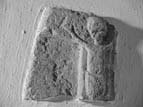
Object type: Fragment of crucifixion
Measurements: H. 17.5 cm (6.9 in); W. 14 < 16.5 cm (5.5 < 6.5 in); D. 3 cm (1.2 in) visible
Stone type: Yellowish grey (5Y 7/2), matrix-supported, micritic shelly oolite. Ooliths, which form about 75% of the stone range from 0.3 to 0.6 mm across; most ooliths have weathered or fallen out to give an 'aero-chocolate' texture. Sub-rounded shell fragments up to 3 mm form about 5% of the stone. Farmington Freestone?, Taynton Limestone Formation, Great Oolite Group, Jurassic.
Plate numbers in printed volume: Ills. 413-4; Figs. 31D
Corpus volume reference: Vol 10 p. 240
(There may be more views or larger images available for this item. Click on the thumbnail image to view.)
Discovered in November 1966 during the excavation of a dry area around the south transept and along the south side of the nave between the transept and the south porch (Gloucestershire Archives D 6881/6 (letters dated 7 November 1966 and 12 March 1967 from W. I. Croome), P70 VE 2/2 (minutes of P.C.C. meetings dated 15 December 1966 and 29 March 1967) and GDR/F1/1966/1840 (faculty showing extent of dry area)). Despite the presence of the incumbent, the Chairman of the Diocesan Advisory Committee, and two architects at the time of the discovery, the exact find spot does not seem to have been recorded.
Small fragment of a crucifixion. The remaining edge of the backing stone is curving. The figure of Christ hangs from a cross which has a broad shaft and cross-arms. The stone is broken across the top of the cross-arms, down the right side of the cross and across the bottom. The figure had a round head on a long neck. There are faint remains of short hair or a small, close-set halo around the sides and top of the head, but no features of the face survive. The lower part of the head is also deeply scarred by two crossing cuts. The figure's chest is rather tubular with some outlining of the muscles and ribcage, while the lower body is covered by a loin-cloth. The arms are thin and the right hand (the left is missing) is little more than a fan-shape across the face of the cross-arm. The cross stands about 1.5 cm (0.6 in) proud of the background and the figure is, at maximum, a further 1.2 cm (0.5 in) deep.
The scale of this little figure, taken with the curving edge of the backing stone, suggests that this is part of a small grave-marker. The curving stone is similar in scale and shape to the grave-marker from Brimpsfield and the rather more angular but similarly sized grave-marker from Edgeworth, no. 2 (both Gloucestershire, Ills. 85–6, 241). The close, 'helmet' style of the figure's hair or halo is rather like that on figures on two tenth-century cross-shafts from Brompton, northern Yorkshire (nos. 3 and 5: Lang 2001, 66–9, ills. 38, 40, 44), and on a 'rustic' ninth- to eleventh-century shaft from Yetminster, Dorset (Cramp 2006, 127, ills. 153–8). The North Cerney stone could be late tenth or eleventh century.
