Select a site alphabetically from the choices shown in the box below. Alternatively, browse sculptural examples using the Forward/Back buttons.
Chapters for this volume, along with copies of original in-text images, are available here.


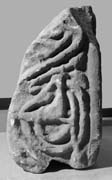
Object type: Part of cross-shaft
Measurements: H. 46 cm (18.1 in); W. 34.8 > 34 cm (13.7 > 13.4 in); D. 30 > 27 cm (11.8 > 10.6 in)
Stone type: Yellowish grey (5Y 7/2), non-calcareous, clast-supported sandstone. The clasts range from 0.2–0.6 mm, but are mostly between 0.3 and 0.4 mm. There are a few white mica flakes up to 0.8 mm across. Bromsgrove Sandstone Formation, Sherwood Sandstone Group, Triassic.
Plate numbers in printed volume: Ills. 597-600; Figs. 27P, 34G
Corpus volume reference: Vol 10 p. 340-1
(There may be more views or larger images available for this item. Click on the thumbnail image to view.)
Presented by Dr A. I. Simey to Rugby School Museum in 1919. Formerly in a garden in Horton Crescent, Rugby and considered likely to have been discovered during the rebuilding of St Andrew's church, Rugby in 1877 (Cottrill 1935b).
Shaft fragment, cut obliquely across faces B and D with none of face C surviving. The carving is in quite high relief with a square-section edge moulding. The back of the stone has actually been cut in a curve, and this might indicate that the stone was reused as a lintel or simple tympanum with face A downwards.
A (broad): There are two figures on this face, each set within arched frames. The lower figure survives only as a triangular head and the upper part of a collar. The eyes are tiny and drilled, while the mouth is defined by little more than a scratch. There is some indication of short hair around the crown of the head. The upper figure is complete and swathed in a voluminous over-garment. The figure's head is very similar to that of the lower figure, with an exaggeratedly pointed chin. Below the chin it is just possible, in raking light, to discern a high-necked undergarment which may be covered with vertical stripes. The figure holds a large rectangular object, presumably a book, in his left hand, while the right arm is bent at the elbow and the right hand touches the book. A triangular area of folds in the garment below the book betrays the figure's left knee and confirms that the figure is seated. A long, heavy drape of material is folded back over the right arm at the elbow.
B (narrow): There is a well-carved spiral plant-scroll with sweeping stems and narrow-stemmed volutes from which spring downward-curving side shoots. Two complete volutes survive, at the centres of which are rosette berry bunches. Paired, triangular leaves grow on straight stems from the heavily ridged nodes.
C (broad): Destroyed
D (narrow): This face also carries a spiral plant-scroll but the only surviving volute is squashed into the frame and one side is very distorted. At the centre of this volute sits a small bird with a rather long neck. The bird's head is turned backwards to peck at a berry bunch. A pair of curling-tipped leaves grow on a long straight stem from the node at the bifurcation point between the volutes. The surface of the node is too damaged to establish whether it is ridged. There is what looks like the remains of a creature in the surviving lower part of the next volute above the bird.
Tiers of very similar figures with wedge-shaped faces and seated under arches can be found on one of the Bakewell crosses, and also on a cross from Eyam, both in Derbyshire (Routh 1937, 5–7, 27–8, pls. II, XIV; Cramp 1977, 192, 219–24, fig. 60; Hawkes 2007, 435, 437, figs. 24, 26), and the Rugby shaft has been seen as a distant outlier of a Derbyshire Peak District group (Cramp 1977, 192). This suggestion is supported by the similarity between the plant-scrolls on face B at Rugby and the Bakewell cross. In each case the plant-scrolls have tightly curling volutes at the centre of which are rounded berry bunches (Hawkes 2001, 231). The nodes are ridged, and opposed pairs of sharply pointed leaves fill the interstices. The bird perched on the rather distorted plant-scroll on face D at Rugby is perhaps more closely paralleled (in concept if not in execution) to the bird on face B of Gloucester St Oswald 1 (Ills. 266, 269) or perhaps to some of the birds on the broad frieze at Breedon-on-the-Hill, Leicestershire (Jewell 1986, pl. XLV).
The gesture of the face A figure, in which the right hand touches a book held in the left hand, is seen in many Anglo-Saxon images both of Christ and the apostles. Hawkes places them among a group that she defines as iconic portrait-type images (Hawkes 2007, 437). However, there is no halo so this is almost certainly not Christ. Instead the carving is probably that of an apostle and should be compared with images like the miniatures of Matthew, Mark and John from the Book of Cerne, an Insular Latin prayerbook of Mercian origin that has been dated to the first half of the ninth century (Cambridge, Univ. Lib., MS Ll.i.10, fols. 2v, 12v, 31v: Brown 1996, pls. ii–iv; and see Ills. 773–4 below).
If this fragment does indeed come from Rugby, it is not easy to suggest a historical context for it. There is a thin scatter of Danish and partly Danish place-names in north-east Warwickshire, but Margaret Gelling has argued that in the case of Rugby, the suffix –by in fact represents a refashioned English name in –byrig (Gelling 1992, 135–8). If she is right, then it is possible that Rugby was an early, perhaps minor, minster, as Old English –byrig (meaning 'enclosed place') seems on occasion to have acquired a secondary meaning of 'minster' (Blair 2005, 250). However, Rugby shows no signs of such status at the time of the Domesday survey when it was a minor settlement of 2? hides (Morris 1976, no. 17, 25). Moreover the parish was of small size and, when first recorded in the late twelfth century, St Andrew's was a chapel-of-ease to Clifton-upon-Dunsmore; it was only with the establishment of a market in 1255 that Rugby started to develop into a place of more significance (Salzman 1951, 202–10).
