Select a site alphabetically from the choices shown in the box below. Alternatively, browse sculptural examples using the Forward/Back buttons.
Chapters for this volume, along with copies of original in-text images, are available here.


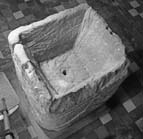
Object type: Font 1
Measurements:
H. (external) 72.5 cm (28.5 in); (internal — depth of bowl) 30 cm (11.8 in);
W. (external) 59.5 cm (23.4 in) (N/S) by 56 < 57 cm (22 < 22.4 in) (E/W); (bowl, internal) 50 cm (19.7 in) (N/S) by 45 cm (17.7 in) (E/W); width of rim: c.5 cm (2 in)
Stone type: Forest of Dean red sandstone, probably from one of the local quarries.
Plate numbers in printed volume: Ills. 748-50
Corpus volume reference: Vol 10 p. 385-6
(There may be more views or larger images available for this item. Click on the thumbnail image to view.)
The font is rectangular in elevation and almost square in plan. The lower part of the body of the font has rounded corners at the south-east and south-west, and sharp right-angles at the north-east and north-west. The north face is much flatter than the other three faces, and this might indicate that it has been re-cut or that it was originally set against a wall. The upper part of all four faces carries four broad borders separated by shallow grooves. The third border down from the top is further decorated with squarish pelleting with 14 on the west face, 13 on the south, 16 on the east and 14 on the north. Below these bands the lower part of each face is covered by two large, half-lozenges, recessed below the surface and point to point with a narrow gap between the points. The lozenges are carried around the corners to be completed on the adjacent faces. The bowl itself is shaped like an inverted trapezoid, straight sided and a flat base 29 cm (N/S) by 27 cm (E/W) bowl. There is a central drain hole in the bottom of the bowl, and pairs of drilled holes near the centres of the south and north rims.
Appendix K item (Fonts and stoups in the Western Midlands).
This font is almost certainly eleventh century in date, but whether pre- or post-Conquest is rather more difficult to establish. The lozenges do look like other early Norman work, but the pelleting would be equally at home in the later Anglo-Saxon period. It has been suggested that the font might be a reused Roman altar, largely because of its 'square' shape (Bond 1908, 99; Fryer 1909, 311–12), although Scarth had earlier discounted this and instead wrote, 'There is no reason why it may not be pre-Norman [but it would] probably be most safe to regard the Staunton font as of uncertain date, but certainly not later than the earliest Norman times' (Scarth 1880–1). The present author agrees with Scarth that there is nothing intrinsically Roman about the stone from which this font is carved, and the development of settlement in the area (see below) could support a date in the later Anglo-Saxon period for the font rather than early Norman. The font may have originally stood on a low plinth as it does today (see also Chapter V, Further thoughts on fonts, pp. 62–4).
According to Domesday Book Earl Godwine held a manor of one hide at Staunton in 1066; a further hide at 'Brocote' (perhaps at Upper Redbrook) was held by Beorhtric. Both manors were stated to have been waste in 1066 and to remain in the king's wood (i.e. the Forest of Dean) in 1086 (Thorn and Thorn 1983, no. 1, 74; Moore 1987, 121–4). A settlement was certainly in existence by 1144 when the gift of the church to Monmouth priory was confirmed; the date of the original gift is unknown, but may have been notably earlier (Herbert 1996, 276, 281, 295).
[1] There are, beside the Deerhurst font in Gloucestershire which has been shown to be of ninth-century date (Deerhurst St Mary 3, p. 163, Ills. 132–44, 740), a number of fonts in the study area that have been said to be Anglo-Saxon or could be Anglo-Saxon. There are also objects like Bisley All Saints 6 (below, Ills. 732–4) that has been described as a font fragment, and Kenchester 1 (p. 382, Ills. 735–6) that now functions as a font, but that are much smaller than all of the other vessels and may, therefore, have originally been used as stoups or lavabo bowls (see below, and 'Further thoughts on fonts' in Chapter V, pp. 62–4, Table 1). In the following Appendix three vessels that were probably stoups have been listed first, followed by the fonts in chronological order by form (cylindrical tub fonts, square tub fonts, tapering or cone-shaped fonts, and bowl-shaped fonts). Some clearly belong to the Overlap period but are included because they show continuity of form and decoration into the later decades of the eleventh century and beyond.
The tub font at Deerhurst is the earliest securely datable font, and an eighth-century Anglo-Saxon ivory panel in the Victoria and Albert Museum that depicts the baptism of Christ also show a tub font (Beckwith 1972, 119, cat. 5, ill. 20). Tub fonts have, therefore, been placed first in the catalogue below. However, in the south-west of England the earliest surviving fonts are bowl-shaped (copies of domestic bowls) and it seems inherently likely that both tubs and bowls were in use at the same time (Cramp 2006, 38; Blair 2010).
Many of the western Midlands fonts seem to have been carved from newly worked stone, but several are carved into reused Roman capitals and bases. One of the reused Roman bases (at Woolstaston, Shropshire), almost certainly came from the Roman city of Viroconium (Wroxeter) but, unlike the similarly reused bases at Wroxeter St Andrew and Shrewsbury Abbey (pp. 390, 389, Ills. 762–3, 768–70), this vessel has been very crudely reshaped and the bowl is only 8 cm deep (p. 386, Ills. 756–7). It does not look like a font at all but it would, in fact, be ideal for the baptism of adults by affusion or aspersion. Adult baptism must have been very rare by the later Anglo-Saxon period, so it seems possible that the Woolstaston font might be very early, perhaps even sub-Roman.
