Select a site alphabetically from the choices shown in the box below. Alternatively, browse sculptural examples using the Forward/Back buttons.
Chapters for this volume, along with copies of original in-text images, are available here.


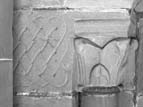
Object type: Part of cross-shaft
Measurements: H. 29 cm (11.4 in); W. (total) 50.5 cm (19.9 in); (of interlace panel) 31 cm (12.2 in); D. (visible) 20.5 cm (8.1 in)
Stone type: Moderate orange pink (10R 7/4) to moderate reddish orange (10R 6/6) very fine-grained to fine-grained sandstone. Grains well sorted, angular to sub-angular consisting of quartz, feldspar, mica and some dark minerals. Grain size 0.08 to 0.125 mm mainly around 0.1 mm. Bedding parallel to top and bottom. Stone is the same as in the more recent porch. Bromsgrove Sandstone Formation, Sherwood Sandstone Group, middle Triassic.
Plate numbers in printed volume: Ills. 658-9
Corpus volume reference: Vol 10 p. 364-5
(There may be more views or larger images available for this item. Click on the thumbnail image to view.)
This stone would seem to have been part of the nave south doorway since the twelfth century; it was noted in its present position by Stockdale (1911, 19).
Part of a reused cross-shaft or possibly a headstone, on one end of which is a rather fine late twelfth-century leaf capital for the south doorway. This capital has been carved onto the blank lower part of the original shaft.
Above the blank portion (to the left as it is set in the wall) there is a panel of flat incised interlace, the strands of which are c. 1.4 cm (0.6 in) wide. The intersections of the interlace are marked with small drilled holes as a layout guide. The interlace itself is simple and regular, but a problem has occurred with the layout in what is now the upper right corner. The original shaft was rectangular in plan and the interlace panel fills the whole width of the only face that is visible. There are no edge mouldings, but these may have been trimmed off when the stone was reused.
Flat, incised carving is generally a feature of later Anglo-Saxon carving in southern England. Examples can be found in the treatment of the garment worn by the crucified Christ at Walkern, Hertfordshire (Tweddle et al. 1995, 240–1, ill. 397), and on an incised headstone at Shrewsbury (St Mary 1, p. 309, Ills. 548–50). In Gloucestershire there are two mid eleventh-century incised inscriptions at Deerhurst (Odda's Chapel 1–2, pp. 190, 195, Ills. 226–33), an incised eleventh-century sundial at Stowell (p. 274, Ills. 494–5), and an incised grave-cover from Swindon Village (p. 265, Ill. 484). A date in the eleventh century would, therefore, seem acceptable for the Stoke Prior piece.
