Select a site alphabetically from the choices shown in the box below. Alternatively, browse sculptural examples using the Forward/Back buttons.
Chapters for this volume, along with copies of original in-text images, are available here.


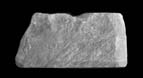
Object type: Part of cross-base or frieze(?)
Measurements: H. 22 > 20 cm (8.6 > 7.9 in); W. 39 > 35 cm (15.3 > 13.8 in); D. 19 cm (7.5 in)
Stone type: A layered rock with three lithologies. The carved face (c. 3 cm thick) and back are essentially similar and consist of pale orange (10YR 8/2), weakly calcareous, poorly sorted, clast-supported, dominantly medium-grained sandstone. The sub-angular to sub-rounded quartz grains vary from 0.2 to 1.0 mm, but are mostly between 0.4 and 0.6 mm across; there are a few sub-angular clasts up to 2.0 mm. The inner portion (11 cm thick) is finer grained with clasts ranging from 0.2 to 0.5 mm, but mostly in the range 0.2 to 0.4 mm. St Maughan's Formation (Lower Old Red Sandstone Group, Old Red Sandstone Super Group), early Devonian.
Plate numbers in printed volume: Ills. 523-8; Fig. 34H
Corpus volume reference: Vol 10 p. 292-3
(There may be more views or larger images available for this item. Click on the thumbnail image to view.)
First discovered following plaster-stripping of the south wall of the chancel in 1860. New arrangements were made in 1880 during the construction of a new vestry on the south side of the chancel. 'Under the S.E. window of the Chancel, there was a small buttress, but the new Vestry giving much greater support to the old wall the buttress was removed, excepting the upper stone which affords a shelter to the small but interesting fragments lately inserted in this place' (Havergal 1883, 14–15). In 2004–5 all the fragments were taken down and, ultimately reset inside the church. Two are identifiable as later medieval pieces. Ray describes them as part of a flat tomb cover and the other an architectural feature bearing a human face (Ray 2006, 1). The third (here Upton Bishop 1), depicts figures in arched niches. Havergal regarded this stone 'as the earliest in the building'.
'Panel' with figures in arched niches. The stone has a flattish top and a sloping right side. The carving is in high relief (up to 3.5 cm (1.4 in) deep) and consists of the upper part of a figure standing within an arched niche. The capital and abacus to the right of the figure are defined with incised lines, and the badly weathered remains of the capital and abacus to the left of the figure indicate that they were also defined in a similar manner. The figure has a rounded face with large, lentoid eyes, a flattened nose, rather prominent ears and a down-turned mouth. The hair is carved in rows of squarish curls. The figure wears an over-garment which has a broad, down-turned collar and is open at the front. There is a wide band on the cuff around his right wrist. The top of a small rectangular object can be seen in front of the figure's chest, and his right hand is raised, with the palm outwards and the fingers straight. A small fragment of a second figure, also within a niche but with his left hand raised, survives to the left of the more complete figure.
It has been suggested that the stone may be part of a frieze (Hunt 2009, 198). However, the sloping side of this stone is an indication that it could instead be part of a cross-base similar to that from Auckland St Andrew, Co. Durham (Cramp 1984, 37–40, pls. 1.1–2, 2.4, 5.15).
The figure's hair style, arranged in rows of tight curls, is like that found on some Carolingian ivories which copy classical curls (Cramp 1975, 195). This hair style is also similar to the seventh-century frescoed head of a saint, probably St Sebastian, in the Sotterranei di San Saba in Rome (Milella 2005, 94, ill. 116). In other respects the figure's round beardless face, prominent ears, flattish nose and down-turned mouth are like the features of the Abraham figure on face C of the Newent 1 cross, Gloucestershire (p. 232, Ill. 395; Newent is only a few miles away). The distinctive hairstyle cannot be compared because the Newent Abraham wears an elaborate headdress, and the eyes are treated rather differently, with those on the Upton Bishop figure being lentoid in shape and convex in profile and those on the Newent Abraham being rounder and slightly sunken. This difference apart, however, the two faces are so similar that the present author believes they could be the work of the same carver or one inspired by the other. Hunt has suggested parallels with eighth-century figures on metalwork from Rinnagan, near Athlone, Co. Westmeath (Ireland) and on a crozier from Helgö (Sweden) (Hunt 2009, 187–8). A closer parallel is offered by the miniature of John from the early ninth-century Book of Cerne. Here the face is rather more oval but the features are very similar and the hair is shown as stylised braids and curls (Brown 1996, 190, pl. IVa; this volume Ill. 773).
The small rectangular object, that the Upton Bishop figure probably holds in his left hand, might be the upper arm of a small cross but looks more like the top of a narrow book or a scroll. His raised right hand, and the similarly raised left hand of the second figure has led to the suggestion that these could be 'orans' figures like those on the Late Roman wall painting from Lullingstone in Kent (Meates 1987, 14–17, figs. 5, 6 and pl. XII). This is possible, and there are tenth-century carved examples from Cheshire (Neston 1) and Lancashire (Whalley 1 and possibly Heysham 5) (Bailey 2010, 85–6, 201–4, 242–4, ills. 197–8, 521–3, 660–3, 665, 667–70). There are also Welsh examples on the tenth-/eleventh-century cross-carved stones at Llanfrynach and Llanhamlach, Breconshire (Redknap and Lewis 2007, 200–2, 210–13, cat. B26, B32).
As with the example from Neston (above) and others from Winwick in Lancashire and Nunburnholme in eastern Yorkshire, the Upton Bishop figure seems to be a priest wearing mass vestments (Bailey 2010, 254–9, ills. 708, 715; Lang 1991, 189–93, ills. 710, 720, 728). The Upton Bishop figure is not, however, holding a chalice or the host. Instead he has probably raised his hand in blessing or liturgical salutation. On a ninth- or tenth-century fragment of carving from Avebury, Wiltshire (Cramp 2006, 200–1, ill. 394) there is a scene in which a figure receives a blessing from a second figure. Only the hands of the second figure survive, but both are fully extended like the Upton Bishop hand. The head of the first figure is rounded with a broad nose and tightly curled hair. The treatment of the eyes is different and the lower face is damaged, but the figure wears an enveloping garment with broad, down-turned collars and open at the front. Over the garment there is what might be a stole or pallium, suggesting that the scene could be a depiction of a bishop receiving a blessing from Christ.
If the 'colleague' to the left of the Upton Bishop figure has both hands raised, then he might be an orans worshiper or another priest opening his arms in inclusive welcome, calling the people to share at the Lord's table.
The manor of Upton Bishop was in the possession of the bishop of Hereford at the time of the Domesday survey, and reference is made to the existence there of a haia (a fenced enclosure associated with hunting) (Thorn and Thorn 1983, no. 2,25; Liddiard 2003). There is no pre-Conquest evidence for Upton Bishop, but it is at least possible that Upton Bishop was in episcopal hands at a much earlier date, perhaps as a hunting lodge (see further Chapter III above, pp. 21–2).
Ownership by the bishop of Hereford might offer further, if rather oblique, support for the interpretation of the Upton Bishop figure as an ecclesiastic. The carving has been dated to the late Roman period (R.C.H.M.(E.) 1932, 194, pl. 78 and Ray 2001, 107–9), the twelfth century (Henig 1993, 79) and the early ninth century (Hunt 2009, 198–206, 211–12). The present author believes that a similar date to the Newent cross in the early ninth century is the most likely.
