Select a site alphabetically from the choices shown in the box below. Alternatively, browse sculptural examples using the Forward/Back buttons.
Chapters for this volume, along with copies of original in-text images, are available here.


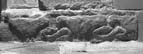
Object type: Architectural fragment: carved panel
Measurements: H. 16 cm (6.3 in); W. 65.5 cm (25.7 in); D. unknown, but at least 24 cm (9.4 in)
Stone type: Moderate reddish orange (10R 6/6), slightly friable, fine to medium-grained (0.2 to 0.4 mm) sandstone. Grains mainly angular to sub-rounded quartz. Difficult to examine. Broken surface close to woodwork. Probably a sandstone within the Salop Formation, Warwickshire Group of Upper Carboniferous, but could be from the Bromsgrove Sandstone Formation, Sherwood Sandstone Group, middle Triassic.
Plate numbers in printed volume: Ill. 570, Figs. 20F, 24L
Corpus volume reference: Vol 10 p. 318
(There may be more views or larger images available for this item. Click on the thumbnail image to view.)
Described in its present situation and illustrated by Cranage (1894–1912, II, 653, fig. 68).
Carved panel with birds. A row of three round-bodied birds (chickens or more probably geese) are carved in relief. The birds all face in the same direction and have small heads with large beaks, short wide tails and narrow legs with forward- and backward-facing clawed toes. The central bird has a tiny wing carved in higher relief. The birds are depicted in the act of pecking at S-shaped worms or snakes which have triangular heads and tails. The panel carries a broad border across the top and a narrower border (probably trimmed back) across the bottom. The head of the eastern bird and the tail of the western bird are missing, indicating that the panel was originally longer or part of a relief that was carved on more than one stone.
There is no record that suggests that this stone was reused as part of the eighteenth-century repair work (like the sections of the cross in the south wall; see no. 1 above). Instead the stone appears to have been reused simply as building material in the southern respond for the twelfth-century chancel arch. This early context for the stone's reuse and the fact that it is carved from sandstone shows that it could not have been part of the Wroxeter cross that, as we have seen above, was carved from oolitic limestone and was still standing in the eighteenth century. This is an important distinction, because it could mean that the stone was originally part of a decorated impost or string-course, similar in subject matter if not in quality to one of the early ninth-century friezes from Breedon-on-the-Hill, Leicestershire (Jewell 1986, pls. XLII–XLIII, XLV). This in turn might indicate that the stone is the last fragment of carving from the pre-Conquest church at Wroxeter of which the present north wall of the nave might be surviving fabric (Moffett 1990, 8, figs. 14, 15). Another possibility is that the carving was part of a Roman frieze or string-course recovered from the site of the adjacent ruined Romano-British city, like an example from Hexham as suggested by Taylor and Taylor (1965, ii, 694–5). However, apart from a partial similarity of subject matter, the birds and swags of foliage on the Hexham stone are quite unlike the Wroxeter chickens or geese, and a Romano-British origin for this carving has been discounted by the present author.
