Select a site alphabetically from the choices shown in the box below. Alternatively, browse sculptural examples using the Forward/Back buttons.
Chapters for this volume, along with copies of original in-text images, are available here.


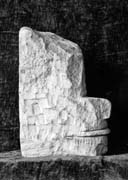
Object type: Animal-head label stop
Measurements: H. (overall) 40 cm (15.7 in); (head) 17 cm (6.7 in); W. (neck) 18 < 19 cm (7.1 < 7.5 in); (head) 15 cm (5.9 in); D. (neck) 18 cm (7.1 in); (at the top of the head) 27.6 > 26 cm (10.8 > 10.2 in)
Stone type: Yellowish grey (5Y 8/1) oolite, sparry matrix supported with hollow ooliths. No visible shell debris. Ooliths 0.2 to 0.5 mm. Cleeve Cloud Member, Birdlip Limestone Formation, Inferior Oolite Group, Middle Jurassic. Probably from Bredon Hill.
Plate numbers in printed volume: Ills. 702-7
Corpus volume reference: Vol 10 p. 371
(There may be more views or larger images available for this item. Click on the thumbnail image to view.)
Found in the south wall of the nave during the major restoration of 1888–9 (Hopkins 1887–8, 429).
Animal-head label stop (or possibly a corbel). This is one of a rather ill-matched pair of crude animal heads from this church (see also no. 2 below). The 'neck' of the creature was clearly designed to be built into the wall so that the head hung down flush with the wall face. The open, rather square jaws are full of square teeth clenched on to the tip of the creature's tongue. The top (front face of the beast) has been cut back, but was presumably originally similar to no. 2. One side of the head and 'neck' has also been trimmed back.
These two animal heads (nos. 1 and 2), together with the capital no. 3, offer a clear indication that there was a stone church on this site before the early Norman church of which the chancel arch and possibly some of the wall fabric still survives. The size of the animal heads suggests that they either acted as label stops to the hood-moulding of a large arch, possibly the chancel arch, or that they were designed as corbels. The crudeness of the carving makes it difficult to date, but a tenth- or early eleventh-century date would be acceptable.
The site of the church in Wyre Piddle is important in that, during the extension of the nave to the west in 1888, two sixth-century pagan Anglo-Saxon graves were found with shield bosses and a knife. The skeletons are described as being 'placed in a sitting posture (presumably crouched), facing north-east. They were the remains of men of large stature ... The one skeleton had been placed to sit behind the other, and a little more to the west' (Hopkins 1887–8, 427–8; Blair 2005, 237, n.237). This is, therefore, a rare example of the placing of a church in a pre-existing pagan burial ground.
The church at Wyre Piddle was a chapelry of nearby Fladbury (Hooke 1985, 134, fig. 33; Bond 1988, 124, 134). Fladbury was an important episcopal minster beside the River Avon (Sims-Williams 1990, 92–3, 118–19, 132–3, 144–6); no sculpture is known from Fladbury itself, but for sculpture from another probable chapelry of Fladbury, see Rous Lench above (p. 363).
