Select a site alphabetically from the choices shown in the box below. Alternatively, browse sculptural examples using the Forward/Back buttons.
Chapters for this volume, along with copies of original in-text images, are available here.


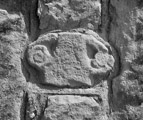
Object type: Gable cross?
Measurements: L. 20 cm (7.9 in); W. 10 cm (3.9 in); D. Built in
Stone type: Dolomitic Limestone, pale yellow-buff, finely crystalline structure. From the local Cadeby formation
Plate numbers in printed volume: Ills. 149-50; Fig. 31
Corpus volume reference: Vol 12 p. 201
(There may be more views or larger images available for this item. Click on the thumbnail image to view.)
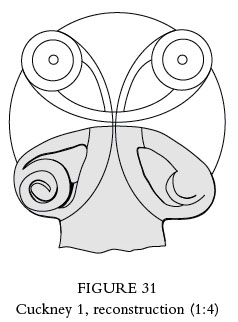
This stone is perhaps best interpreted as the central section of an elaborately carved gable cross. In such an interpretation the stone contains the uppermost part of a thick stem, by means of which the cross would have been secured to the gable itself. The presumed stem itself has chamfered angles. The remainder of the carving on the stone would represent the lower cross-arm of a cross pattée, embellished with circular bosses located between the tips of the cross-arms. These bosses are enlivened with concentric incised lines, turning them into whorls, as are the edges of the lateral arms of the cross itself (see reconstruction in Fig. 31).
Appendix A item (stones dating from Saxo-Norman overlap period or of uncertain date)
If it is correctly interpreted as a gable cross, this stone will represent an early surviving example. The cross form would perhaps indicate a twelfth-century date, although the bosses apparently located between the cross-arms in this fashion are hard to parallel. They do occur, however, on early sketches of the so-called Sciloc Cross at Merthyr Mawr (Glamorgan), made before the cross-head itself was broken away. Here the form has been dated to the eleventh century (Redknap and Lewis 2007, 460–5, ills. G98a–b). In the East Midlands, the form of cross with the arms composed of sub-circles derived from the Euclidean method for dividing up a circumference into equal sectors and with bosses between the tips of the arms begins as an Anglo-Saxon cross form. The best surviving example is at Rowsley (Derbyshire) only some 15 miles from Cuckney, with another published from Bardney in Lincolnshire (Routh 1937, 35–6, pl. XVIII; Everson and Stocker 1999, 97–8, ills. 4–5). So the suggested reconstruction is not that much of a departure in terms of cross-head form, though there is no sign of interlace on the cross-arms at Cuckney. The cross pattée head type, developed from Anglo-Scandinavian forms, occurs widely in Nottinghamshire on grave-covers and grave-markers of the twelfth century. A listing of examples noted during Corpus fieldwork has been given below in Appendix F (p. 223). Other options for reconstruction of this piece should be borne in mind, however. It is conceivable that Cuckney 1 actually represents an elaborate form of disc-headed grave-marker (as at Merthyr Mawr), though with a similar reconstruction to that proposed as a gable-cross. Unfortunately, no parallels for grave-markers decorated in this fashion have come to light either.
