Select a site alphabetically from the choices shown in the box below. Alternatively, browse sculptural examples using the Forward/Back buttons.
Chapters for this volume, along with copies of original in-text images, are available here.


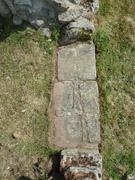
Object type: Three fragments from large grave-cover
Measurements:
a: L. 46 cm (18.1 in); W. 48 cm (18.9 in); D. > 13 cm (5.1 in)
b: L. 40 cm (15.75 in); W. 26 cm (10.2 in); D. > 13 cm (5.1 in)
c: L. 32 cm (12.6 in); W. 18 cm (7.1 in); D. > 13 cm (5.1 in)
Overall surviving length approximately 120 cm (47.25 in), incomplete in both directions
Stone type: Dolomitic Limestone, brownish-yellow, oolitic textured. From the local Cadeby formation
Plate numbers in printed volume: Ills. 153-4
Corpus volume reference: Vol 12 p. 203-4
(There may be more views or larger images available for this item. Click on the thumbnail image to view.)
All three stones are decorated with an identical, simple, precisely-cut angle-roll running round the edge of the cover. There is no sign that the roll was ornamented with a cable. Stone 1a has this moulding along both its surviving edges, which gives the width of the original monument as 48 cm (18.9 in), and there is no measurable taper within its limited surviving length. None of the stones displays evidence for the moulding turning at head or foot of the cover: it seems, therefore, that these stones make up much of the centre of the original. The panel within the moulding contains no sign of any decoration, and what survives is not so weathered as to encourage conjecture that there was ever any decoration. Probably the panel was uncarved.
Appendix A item (stones dating from Saxo-Norman overlap period or of uncertain date)
This simple grave-cover is representative of a type of monument that is quite well known in the East Midlands and is usually dated generically to the late eleventh or early twelfth century. Examples in Nottinghamshire include Blyth 1, North Muskham 1 and possibly Halloughton 1, reported here (pp. 199, 202 and below). As with Blyth 1, particular comparison can be drawn with one of the covers excavated from St Mark's church in Lincoln, Lincoln St Mark 27. This had an excavated context and was accorded a twelfth-century date, yet was thought to represent a poor-quality copy of a somewhat earlier monument type (Everson and Stocker 1999, 286, ills. 416–17). What now amounts to a recognizable local monument type in Nottinghamshire is also characterized by its use of a local stone type, rather than an imported limestone. This, too, is a feature of the latest pre-Conquest and earliest post-Conquest stone monuments of a workaday type — grave-covers and -markers in the county.
Mattersey Priory was not founded as a Gilbertine house until 1185 (Charlton 1972, 3–4). So, in contrast to the very similar grave-cover at Blyth, it is perhaps less likely that this monument marked the grave of an early patron or convent member. Rather, it might represent the first tangible evidence that there was an earlier ecclesiastical presence on the island in the floodplain of the River Idle, to which — in a familiar pattern — the priory was a successor.
