Select a site alphabetically from the choices shown in the box below. Alternatively, browse sculptural examples using the Forward/Back buttons.
Chapters for this volume, along with copies of original in-text images, are available here.


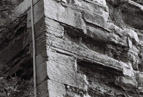
Object type: Large grave-cover in two parts
Measurements:
a: L. c. 130 cm (51.1 in); W. c. 30 cm (11.8 in); D. c. 30 cm (11.8 in)
b: L. c. 130 cm (51.1 in); W. c. 30 cm (11.8 in); D. c. 30 cm (11.8 in)
Stone type: [A golden-coloured stone, perhaps Dolomitic Limestone from the Cadeby formation]
Plate numbers in printed volume: Ills. 155-9
Corpus volume reference: Vol 12 p. 204-5
(There may be more views or larger images available for this item. Click on the thumbnail image to view.)
The two stones appear to be mirror images of each other. Together they will have formed a long chest-like grave-cover standing some 30 cm proud of the ground surface. The arrises between the sides and the lid were decorated with a pronounced angle-roll, and it seems clear (from the south end of stone 1a, at least) that the angle-roll did return along one end — and probably therefore both ends.
Appendix A item (stones dating from Saxo-Norman overlap period or of uncertain date)
The archaeological context of these two stones is critical. First, their reuse symmetrically in the north-west and south-west quoins of the tower strongly suggests that the two stones belong to the same original monument, cut in half longitudinally for recycling here. Furthermore, the tower in which they are reused is comparatively securely dated to the later twelfth century, and this in turn implies a date no later than the early twelfth century for the production of the grave-cover. In fact a date in the late eleventh or early twelfth century would be expected by comparison with the similar grave-covers at Blyth 1 and Mattersey 1 (above, Ills. 145–6, 153–4), of which the former is unlikely to be much earlier than the foundation of the priory there in 1088. A similar date has been argued for an example of this type of monument from St Mark's church, Lincoln (no. 27; Everson and Stocker 1999, 286), whilst the fragment at Halloughton (no. 1, Ill. 151) situated six miles to the south west in Nottinghamshire (p. 202 above) might represent another cover of similar type.
