Select a site alphabetically from the choices shown in the box below. Alternatively, browse sculptural examples using the Forward/Back buttons.
Chapters for this volume, along with copies of original in-text images, are available here.


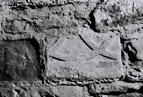
Object type: Two fragments of interlace
Measurements:
a: L. 23 cm (9 in); W. 13 cm (5.1 in); D. built in
b: L. 28 cm (11 in); W. 15 cm (5.9 in); D. built in
Stone type: Limestone, pale off-white, medium to coarse, ooidal and bioclastic, well cemented by calcite. Middle Jurassic, Bajocian, Upper Lincolnshire Limestone Formation, ?Ancaster Hard White Stone
Plate numbers in printed volume: Ills. 84-5
Corpus volume reference: Vol 12 p. 148-9
(There may be more views or larger images available for this item. Click on the thumbnail image to view.)
3a is built into the west wall of the south porch facing east. It is centrally placed about 20 cm above the internal bench.
3b is built into the west wall of the south porch facing west. It is centrally placed and to the south of the window, 140 cm above present ground level.
These two fragments are of an identical stone type and come from a monument which, from their surviving geometry, appears to have been accurately bisected. This pattern of reuse might suggest that the original stone was a shaft which has been 'halved' for reuse (as for example at Minting, Lincolnshire: Everson and Stocker 1999, 327–8). If this is a correct understanding, the 'shaft' would have had angles defined by precisely cut fillets of square section, with decoration within the field in low relief. The surviving strands of interlace, which are very precisely cut, and of U-section, are laid out as a series of interlocking rings or circles. The style of interlace cutting, with large areas of the field being cut away to reveal relatively etiolated strands, is entirely distinct from that seen in the Ancaster grave-cover products, for example on Rolleston 2.
These two stones clearly come from the same original monument and they might be best reconstructed as a shaft. They would represent a second shaft from Rolleston, but one markedly different from Rolleston 1. It would have been large, having a width of some 30 cm, and the pattern of interlinked circles here might suggest that this represents the narrow side of the shaft similar to that which survives more completely at Sproxton, Leicestershire, and has one of its narrow sides decorated with interlocking rings of the type that can be reconstructed at Rolleston (Ill. 186). The date of the Sproxton monument is debated. It is often accepted as being of pre-Conquest date (Clough et al. 1975, 71; Parsons 1996, 16); however, other features of its decoration might suggest that it is better viewed as a shaft of the post-Conquest 'continuing tradition'. An aspect of the Sproxton shaft that differentiates it from Rolleston 3, however, is that it displays an entirely different style of interlace cutting, which belongs to a small group of such late shafts, examples of which survive at Fletton, Ketton and Stanground (Everson and Stocker 1999, 89–90). More similar to the Rolleston fragments, perhaps, is the stone from an equally large shaft at Market Deeping in Lincolnshire (ibid., 225, ill. 287). Market Deeping 1 has very narrow interlace strands of pronounced U-profile defined within large recessed panels, like Rolleston 3. The Market Deeping shaft was a product of the Barnack/Clipsham quarries and, in that respect, was associated with the latest group of pre-Conquest grave-covers from that source, and this perhaps provides the most likely indication of the date of Rolleston 3; i.e. the mid eleventh century. What may be similarly ornamented shaft fragments, from Bibury (no. 5) and Broadwell (no. 1), in Gloucestershire, are also dated to the first half of the eleventh century, though Bryant most recently interprets both stones as 'decorated jambs' (Bryant with Hare 2012, 138, 151).
Without removing these stones from the wall in which they are now set, however, it is impossible to confirm that these fragments do indeed come from a shaft at all. We should record the possibility that they might come from the sides of a decorated Romanesque coffin, of the type still surviving in Lincoln Cathedral with just this sort of precisely cut, etiolated, interlinked circle design (Stocker 1988). The use of interlinked rings, and also the quality and accuracy of the carving, are characteristic of this group of chest-like monuments discussed by Stocker, which are undoubtedly post-Conquest in date. Some individual items might still belong to the late eleventh century, but most are more comfortable in the first half of the twelfth.
