Select a site alphabetically from the choices shown in the box below. Alternatively, browse sculptural examples using the Forward/Back buttons.
Chapters for this volume, along with copies of original in-text images, are available here.


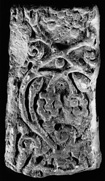
Object type: Part of cross-shaft
Measurements: H. 50 cm (19.75 in); W. (max.) 24 cm (9.5 in); D. (max.) 19 cm (7.5 in)
Stone type: Medium-grained yellow sandstone (Carboniferous)
Plate numbers in printed volume: 380 - 3
Corpus volume reference: Vol 2 p. 120
(There may be more views or larger images available for this item. Click on the thumbnail image to view.)
Sections of a single roll moulding survive on faces A, C, and D.
A (broad): The remains of one complete and two incomplete medallions of a crossing scroll. At the top, the lower portions of two grape bunches; as infilling between the medallions, two tightly curled tendrils tipped by small, pointed, paired leaves, while in the complete medallion two oval grape bunches are suspended from long crossed stalks. The space above the crossing is filled with a single pellet and from the base of the medallion two long stalks sprout up and follow the volute outline. They are tipped with small pointed leaves. At the base of the volute is a tightly curling tendril and as infilling between this and the medallion below there are paired leaves on spiral tendrils.
B (narrow): Broken away.
C (broad): Two volutes of a simple scroll, each volute filled with three counterpointed, oval berry bunches, and from the upper volute triple pointed leaves are suspended.
D (narrow): A form of trail with split stems which form volutes; one complete and two incomplete volutes survive. Each contains a rosette berry bunch and large pointed leaves sprout from above and below the volute.
This piece is closely linked with Heversham 1, Lowther 1 and Lancaster (Ills. 351–4, 436–9, 679–80), in that all have a medallion scroll on one broad face, a spiral scroll on the other and a split stemmed trail on the side faces. (It seems reasonable to suppose that the missing face of this shaft also contained a trail.) The tightly curling tendrils on face A with a deeply marked centre are also a feature of this western group and it is a mannerism preserved as late as Irton 1. Other features, however, such as the counterpointed berry bunches, occur at centres such as Lancaster and Northallerton, Yorkshire (Collingwood 1927a, 36–8). The form of the leaves and grape bunches are not like those on Lowther 1 and Heversham 1, but do resemble other Cumbrian scrolls such as Addingham 1 or Carlisle 2 (see p. 16). Despite the parallels which can be drawn outside the region for individual motifs, as Bailey has demonstrated this shaft belongs to a western group stretching from Lancaster to Hoddom, Dumfriesshire, but excluding the Cumbrian coastal plain (Bailey 1974a, I, 34–6). It is possible that a single workforce was responsible for the whole group.
