Select a site alphabetically from the choices shown in the box below. Alternatively, browse sculptural examples using the Forward/Back buttons.
Chapters for this volume, along with copies of original in-text images, are available here.


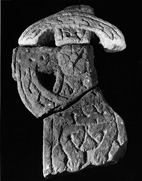
Object type: Part of cross-shaft and -head, in three joining fragments
Measurements: H. 57 cm (22.5 in); W. (centre of rosette to end of arm) 26 cm (10.5 in) (shaft) 24 > 23 cm (9.5 > 9 in); D. 6 cm (2.75 in)
Stone type: Medium-grained, micaceous, pale yellow sandstone (Carboniferous)
Plate numbers in printed volume: 281 - 3
Corpus volume reference: Vol 2 p. 98-99
(There may be more views or larger images available for this item. Click on the thumbnail image to view.)
Cross-head, arm type B6 with circle type 3 on face A and, on face C, arm type A9 with circle type 3. Slab-like shaft.
A (broad): The cross-arms, circle and shaft are bordered by a flat-band moulding. At the centre of the head is a (seven-leaf?) rosette with a central bud. A figure-of-eight knot decorates each of the three remaining arms whilst the circle carries a simple angular twist in stopped-plait technique. On the shaft is the (probable) termination of a ring-chain pattern.
B (narrow): A flat-band moulding borders the ornament on the edge of the circle and side of the shaft. Incised chevrons decorate what remains of the upper quadrants of the circle. The end of the cross-arm carries a figure-of-eight knot whilst the lower quadrant of the circle and the shaft are ornamented with a continuous simple twist.
C (broad): The cross-arms, ring and shaft ornament are all bordered by a flat-band moulding. At the centre of the head is a six-leaf rosette with small central bud. In the right horizontal arm is an irregular triquetra-like knot and there is a similar knot in the upper arm. Two closed-circuit loops decorate the lower arm. The ring quadrants have simple twist ornament. On the shaft is a form of ring-chain which terminates, in the upper right corner, in a zoomorphic head with curled upper lip.
D (narrow): On the upper quadrant of the ring are incised chevrons; the remaining section of shaft carries a simple twist.
Circle-head group (Introduction, pp. 31–2). The combination of both circle and ring head forms is unique. The decoration on the circle is characteristic of the Cumbrian group and both the rosettes and the twist decoration on the narrow faces are found again on Dearham 1, of which this Gilcrux cross may well be a copy. The Borre-derived ring-chain ornament and the Jellinge associations of the beast-head point to a tenth-century date.
