Select a site alphabetically from the choices shown in the box below. Alternatively, browse sculptural examples using the Forward/Back buttons.
Chapters for this volume, along with copies of original in-text images, are available here.


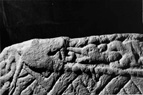
Object type: Part of hogback (the 'Saint's Tomb')
Measurements: L. 156.8 cm (61.75 in); W. 24.1 < 26 > 24 cm (9.5 < 10.25 > 9.5 in); D. 72.4 < 80 > 70 cm (28.5 < 31.5 > 27.5 in)
Stone type: Medium-grained red sandstone (St Bees sandstone)
Plate numbers in printed volume: 323 - 31
Corpus volume reference: Vol 2 p. 106-108
(There may be more views or larger images available for this item. Click on the thumbnail image to view.)
Hogback, type k, but with end-beasts and lacking lateral panels on walls. The side-walls are markedly bombé in plan and the ridge is curved; the gable-ends are flat and inward sloping.
A (long): The roof decoration is bordered laterally by moulding-framed panels containing a three-strand plain plait terminating at the bottom in a tight spiral. Along the ridge is a panel of tightly woven three-strand plain plait bordered above and below by a cabled moulding. At the western end this plait terminates in a beast's head with rounded eye, long jaws and a single hollowed ear. This animal faces the head of the end-beast whose gaping jaws contain a single upper and lower tooth and a curled tongue. The cabled moulding framing the top of the ridge-panel runs into the upper jaw of the end-beast whose bodiless head is set to the east of the lateral frame of the roof. Though the east end of the top of the roof is broken and worn there are clear remains here also both of a zoomorphic termination to the ridge-panel plait and of an end-beast. On the roof is a crudely incised pattern formed by a series of two right-angled strands placed so as to enclose a diamond shape.
Below the eaves-moulding is a full-length wall panel of tightly-woven fleshy four-strand plain plait. This terminates at the left-hand end in three animal heads; all have long jaws and round eyes whilst the two beasts furthest left also have a single hollowed ear. The upper and lower jaws of the two animals furthest right are linked, whilst the left-hand beast whose head is set in the curve of its neck has an extended lower jaw which loops around the neck of the adjacent animal. Between the heads of the two beasts to the left is a naked human figure, seen in profile, sitting astride, and enmeshed in, the lower jaw extension of the easternmost animal. One leg is set in an 'Anglian lock' (Kendrick 1938, 141) and the foot breaks the line of the panel's lower frame.
B (end): Crossless Crucifixion showing Christ with arms outstretched and wearing a short kirtle. The pear-shaped head is set deep into the shoulders and the facial features are drilled and incised. Above his arms and head is a curved plain panel surrounded by a moulding frame (a nimbus?). The ground below Christ's left arm has been cut away but an uncut square remains below his right. There is a vertical feature below the left-hand corner of the kirtle which might be interpreted as a spear but there is no clear evidence that the scene included any subsidiary figures.
C (long): The ornamental arrangement of the roof, with its end-beasts and upper and lateral panels containing plain plait, is identical to that on side A. On the wall beneath the eaves moulding is a full-length panel containing a composition involving four ribbon animals, all of them with round eyes, extended jaws, and a single round and hollowed ear. The heads of the two outermost beasts are set within the curve of their necks and their extended lower jaw passes round the neck of the adjacent inner beast before returning. Astride these jaw extensions, and facing outwards, are two human figures with legs set in an 'Anglian lock' and with their outside feet piercing the bottom of the frame. In the centre of the panel the two innermost beasts face each other, their lower jaws linked and the upper jaw of the one flowing into the body of the other. In each of the lower corners of the panel is a small mask.
D (end): Within the eaves at the top is a triquetra, the strands splitting and interlacing at the crossing point. Below is a Crucifixion scene. Christ is shown without a cross but with arms extended. Details of the clothing are obscure. Two curved plain mouldings (a nimbus?) are set above his head. In certain lights there are traces of a subsidiary figure below Christ's right arm.
The links between this stone and others at Gosforth have been signalled elsewhere (Bailey and Lang 1975). The tightly-woven fleshy plait recurs on Gosforth 1, 2, 6 and 7 as does the terminal spiral. The drilled intersections of the lateral roof panels recall the cutting of the north side of Gosforth 1 and the lower arm of Gosforth 2. The figural type with pear-shaped head set deep into the shoulders and dressed in a short kirtle with pointed ends is found again on Gosforth 1 and 6; (the relationship of this type to Penrith 11 and to an Irish metalwork model is discussed below, pp. 140–2). The beasts with long jaws and rounded ear whose heads are unnaturalistically joined to interlace strands recur on Gosforth 1 (though there stripped of jaw extensions). It seems reasonable therefore to assume that this carving was produced by the same hand as that responsible for Gosforth 1 and most of the carvings at the site (see Introduction, p. 33).
It would follow from these links that this hogback should be dated to the early tenth century. Some writers, however, have classed it with work of the eleventh-century Urnes style (Brøndsted 1924, 227–9; Kendrick 1949, 125) There is no convincing need to accept this analysis. Urnes art is certainly based upon the interplay of broad and narrow strands and on the use of slick curves. These elements are clearly present on this stone. They are not, however, accompanied by any of the head or eye forms which are diagnostic of Urnes styles. Moreover, the interplay of broad and narrow strands in Urnes art is usually one involving the one acting as background for the other and not, as here, separated from each other into distinct areas of the composition. The close links between the art of this hogback and the main cross with its Borre-style elements argues, rather, that Gosforth 5 belongs to the tenth century (Bailey and Lang 1975).
In its distinct roof and vertical walls this hogback recalls the form of shrine-tombs like Hedda's tomb (Cramp 1977a, fig. 57). Its decoration might also owe something to arrangements appropriate to metalwork shrines (e.g. Henry 1970, pl. 34).
Many features of this hogback recur at other sites in the north-west. All may represent a common north-western taste, but equally the repetition of forms and motifs elsewhere in the Cumbrian area could reflect the impact of this important carving, the work of the most accomplished sculptor of the Viking period in Britain. For example, it has the narrow proportions of so many north-western hogbacks and shares the serpent-struggle theme with Penrith 7 and Great Clifton 1. The flat, inward-sloping gable-end recurs on the adjacent Gosforth 4 and on both Cross Canonby 5 and Plumbland 2. The latter hogback has triquetras between the gables as here at Gosforth, whilst Cross Canonby offers the best parallel for placing the end-beast part of the way along the ridge above a lateral roof panel. It may be to the Gosforth master that we also owe the local trick of allowing ornament to pierce the lower frame of a hogback wall-panel which is found on Lowther 4 and Penrith 7.
The combination of end-beast with lateral and ridge panels is an ambitious arrangement, as indeed is the presence of fangs and curled tongue on the end-beast. Individually all of these details can be paralleled: ridge panels on Aspatria 6; narrow lateral panels on Cross Canonby 5 and at Govan, Renfrewshire (Radford 1967a, pl. XIIIb); fangs on Aspatria 6 and at the Yorkshire sites of Wycliffe, Osmotherley and Lythe; and the curled tongue at Darlington, co. Durham (Lang 1984, 128, 152, 156, 168; Cramp 1984, pl. 32, 169). It is, however, the combination of all these elements which distinguishes this carving and which provides such a puzzling contrast to the inept decoration of the roof. This crude ornament might be secondary and by another hand, perhaps as an impressionistic rendering of decoration like that on hogbacks from Dewsbury or Brompton in Yorkshire (Collingwood 1927a, figs. 196, 205), perhaps imitative of woodwork techniques (Shetelig 1920, fig. 23), or possibly merely displaying the incompetence of work like Burton in Kendal 3 or Birstall, Yorkshire (Collingwood 1915a, 145).
The small human masks in the corners of the panel recur again in Viking-period art (Kermode 1907, no. 100; Mageroy 1961, 155); if they carried any symbolism then its meaning is now lost.
