Select a site alphabetically from the choices shown in the box below. Alternatively, browse sculptural examples using the Forward/Back buttons.
Chapters for this volume, along with copies of original in-text images, are available here.


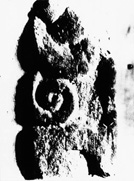
Object type: Fragment, possibly of cross-shaft
Measurements: H. 23 cm (9 in); W. 20 cm (7.9 in); D. 11 cm (4.3 in)
Stone type: Medium-grained red sandstone (St Bees sandstone)
Plate numbers in printed volume: 318 - 19
Corpus volume reference: Vol 2 p. 109
(There may be more views or larger images available for this item. Click on the thumbnail image to view.)
Only a fragment of two adjacent faces remains, divided from each other by a roll moulded border.
A: A modelled three-strand plain plait terminates at the bottom in a tight spiral. Below is a horizontal flat-band border linked to another moulding which curves down, probably to meet the lateral frame.
B: At the upper left is a broad curving strand which terminates in the upper right in a snake-like head with eye and open jaws. Below, and presumably terminating a crossing strand, is the hollow pointed ear and brows of another beast.
The fleshy modelled plait with terminal spiral is closely paralleled by the plait on the upper part of the south face of the main shaft, no. 1, on the 'Fishing Stone', no. 6, and on the roof of the 'Saint's Tomb', no. 5. The animal with hollow pointed ears terminating a strand can also be precisely matched on the main cross. The earless beast, if such it be, cannot be exactly paralleled on any of the other Gosforth sculptures but is, in its long jaws and head-shape, akin to the animal heads on the wall and roof of no. 5. This fragment is therefore almost certainly the work of the Gosforth master (see p. 33) and may be part of the destroyed shaft which still existed in the churchyard in the late eighteenth century ('Carbo' 1799).
The curving moulding on face A may have been the remains of a semi-swag whose development from an Anglian form represented at Sandbach, Cheshire to north-western Viking-age monuments at Whalley and Bolton le Moors in Lancashire is discussed below under Kirkby Stephen 1.
