Select a site alphabetically from the choices shown in the box below. Alternatively, browse sculptural examples using the Forward/Back buttons.
Chapters for this volume, along with copies of original in-text images, are available here.


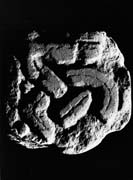
Object type: Fragment of cross-shaft or -head [1]
Measurements: H. 14 cm (5.5 in); W. 15 cm (6 in); D. 12 cm (4.75 in)
Stone type: Fine-grained, calcareous, very pale brown (10YR 7/4) sandstone; Middle Calcareous Grit, Coralline Oolite Formation, Middle Oxfordian, Upper Jurassic; probably from old quarry north-east of church at Stonegrave
Plate numbers in printed volume: 703-708
Corpus volume reference: Vol 3 p. 194
(There may be more views or larger images available for this item. Click on the thumbnail image to view.)
A (broad): A plain edge moulding passes along each side and across the top of the panel. It contains interlace, using median-incised strands, and consisting of a bar terminal and either a simple pattern F loop (Carrick Bend) or a free ring with diagonals. The strands are flat and median-incised. There are two pellet fillers on the left-hand side.
B (narrow): A plain double edge moulding surrounds the top of the panel which contains what is either the upper part of an S-shaped meander, or the end of an angular two-strand twist.
C (broad): This face has a moulding identical with face A's, and contains the remains of an interlace executed in flat median-incised strands. There is a bar-terminal and either a free ring and diagonals or a simple pattern F (Carrick Bend) loop.
D (narrow): A narrow flat edge moulding runs round the top of the panel. Within it another strip of the same width follows it and is decorated with step pattern. Within this is a narrow, rectangular, plain moulding containing an S-shaped meander.
E (top): There are slight, roundish depressions in the top of the stone.
The pronounced taper of the stone suggests that it formed either the top of a cross-shaft or the upper arm of a cross-head. The inner decorative mouldings are found on no. 1, which may be a fragment of the same monument. The close packing of the interlace as well as the taste for closed circuit and straight line patterns, which may have come from the west, are found on many Anglo-Scandinavian monuments in North Yorkshire. The depressions in the top of the fragment seem too shallow for dowel holes but may have been seats for a cross-head of a composite monument.
