Select a site alphabetically from the choices shown in the box below. Alternatively, browse sculptural examples using the Forward/Back buttons.
Chapters for this volume, along with copies of original in-text images, are available here.


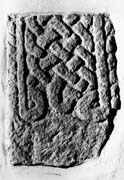
Object type: Part of cross-shaft [1]
Measurements: H. 33.2 cm (13.1 in); W. 24 cm (9.5 in); D. Built in
Stone type: Medium-grained (with subangular grains and weak calcareous cement), very pale brown (10YR 7/3) sandstone; Middle Calcareous Grit, Coralline Oolite Formation, Middle Oxfordian, Upper Jurassic; from immediate vicinity, exposures occurring within 2 km of church
Plate numbers in printed volume: 809
Corpus volume reference: Vol 3 p. 209-210
(There may be more views or larger images available for this item. Click on the thumbnail image to view.)
Only one face is visible.
?B (narrow): At each side is a cabled edge moulding. Within and adjacent to it is an inner moulding, slightly narrower, which terminates at the base of the decorative part of the face in scrolls which turn into the panel space. These contain a six-strand plain plait, using broad, flat strands, the the central included U-bend lying between the scrolls. An incised, upward-curving line runs across the face at the bottom of the ornament.
Collingwood's drawing of the interlace (1907, fig. l on 387) should be viewed with caution and a little more of the top of the stone is now visible. The scrolled terminals to the inner moulding also occur at Levisham 1 (Ills. 631–4) where, after extraction from the wall, a similar face turned out to be the narrow side of a shaft. Compare also no. 7.
