Select a site alphabetically from the choices shown in the box below. Alternatively, browse sculptural examples using the Forward/Back buttons.
Chapters for this volume, along with copies of original in-text images, are available here.


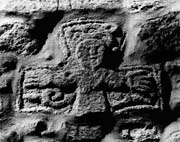
Object type: Part of cross-head [1]
Measurements: H. 21.5 cm (8.5 in); W. 35.5 cm (14 in); D. Built in
Stone type: Coarse-grained, white (10YR 8/2) sandstone; see no. 1.
Plate numbers in printed volume: 814
Corpus volume reference: Vol 3 p. 211
(There may be more views or larger images available for this item. Click on the thumbnail image to view.)
Only one face is visible.
A (broad): A flat perimeter moulding runs round the free-armed cross, arm types A1 and E6. Within is a primitive Crucifixion with head and arms within the limbs of the cross. The hands are large. The eyes are picked, the mouth an incised slit, but the wedge-shaped chin was given some relief. Above the head, matching the curved arm-end, is a twist of flat strand. Below the arm on the left is a serpent whose body coils once and whose head is dart-shaped. There is a rough filler below the other arm.
During the Anglo-Scandinavian period, free-armed crosses are outnumbered by ring-heads in Eastern Yorkshire. This, therefore, may represent an inherited Anglian form, but it is a late type (contrast the Lastingham crosses). The placing of the Crucifixion on the cross-head is typical of Anglo-Scandinavian crosses: compare, for example, Kirklevington, North Riding (Ill. 916). The custom no doubt derives from Irish models, not a surprising source in view of the Dublin-York axis of the mid tenth century (Coatsworth 1987, 162–3). The Sinnington Christ has all the attributes of an Irish Crucifix, for example, the large hands: compare the cross at Castledermot, co. Kildare (Ill. 912). The snake beneath the arm may be a decorative filler, but it should be compared with the lost hogback from York Minster (no. 46; Ill. 189).
