Select a site alphabetically from the choices shown in the box below. Alternatively, browse sculptural examples using the Forward/Back buttons.
Chapters for this volume, along with copies of original in-text images, are available here.


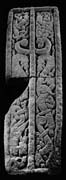
Object type: Grave-cover, in two joining pieces [1]
Measurements: L. 137 cm (54 in); W. 42.5 > 40.5 cm (16.75 > 15.9 in); D. 15.5 cm (6.1 in)
Stone type: Medium- to coarse-grained, very pale brown (10YR 7/4) grit; see no. 2.
Plate numbers in printed volume: 164-168
Corpus volume reference: Vol 3 p. 74
(There may be more views or larger images available for this item. Click on the thumbnail image to view.)
A (top): A wide, boldly modelled cable moulding surrounds the face. At the corners the mouldings are interlocked. The central ridge overrides the moulding but the worn animal-head terminal is inset. It has a muzzled jowl and from it issues the cabled ridge. The lateral limbs of the 'cross' do not meet the edges but curl upwards towards the stem. On the left it has a frontal animal head and on the right a profile one with tongue showing between the jaws and small rounded ears.
In the upper panels formed by the 'cross' there is a mirror-image motif of a fettered profile beast with profile nose-fold, extended ear in median-incised strand, and elliptical eye. The fetter is swallowed by gaping jaws. On the right the hind quarters of the beast are not depicted; on the left one foot hints that the rump is behind the curling zoomorphic terminal.
Below the 'cross' arms the panels are almost mirror image and contain beast-chains of three animals in undulating registers. The uppermost animal has a mane, triple nose-fold, small rounded ears and incised elliptical eyes. The fore leg is extended from a scrolled joint. The stone is cut at their waists but the left-hand animal is winged whilst the right-hand one is not. Below the fracture the right-hand panel's beast has an attenuated leg and tail which interlock with the hind quarters of the next beast, which closely resembles it. Fetters form a Stafford Knot above the second beast's back. The corresponding beast on the left is lost. The lowermost beasts match those at the top of their respective panels: the left-hand one is winged with hanging head, and the right a sprightly profile quadruped.
B–E (sides): Plain, and roughly dressed.
The variety of animal ornament on this slab distinguishes it from the preceding examples. Its closest parallel is the slab All Saints Pavement 1 (Ill. 201) (Pattison 1973, 215). The beast-chains relate more to the shafts than to the slabs, and features such as the triple nose-folds show York Metropolitan School diagnostic characteristics. The carving is deep, modelled and assured, and the treatment of the superimposed cross, reminiscent of the three-dimensional end beasts on hogbacks, is full of originality. Unlike the York winged beasts, the profile beasts have attributes which relate to the Jellings style and a leaning towards Scandinavian taste may be argued.
1. All the pieces from the Minster were discovered as a result of the excavations of 1966-71 by H. Ramm and D. Phillips. They are to be published as a handlist, together with a critical essay, in the forthcoming Royal Commission volume on the excavations. That publication will provide the finer detail of their archaeological contexts, both in a table, and in a description of the excavation of the south transept cemetery.
The following are general references to the stones: Wilson 1978, 142; Hall 1980b, 7, 21; Lang 1988b, 8, 12; Lang 1989, 5.
