Select a site alphabetically from the choices shown in the box below. Alternatively, browse sculptural examples using the Forward/Back buttons.
Chapters for this volume, along with copies of original in-text images, are available here.


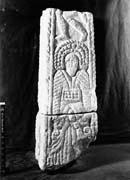
Object type: Part of cross-shaft, in two joining pieces [1]
Measurements: H. 71.2 cm (28 in); W. 25.5 > 23 cm (10 > 9 in); D. 25.5 > 23 cm (10 > 9 in)
Stone type: Coarse-grained, pale brown (10YR 7/4, with brownish-yellow (10YR 6/8) flecks) grit; Millstone Grit, Namurian, Upper Carboniferous; reused Roman ashlar, probably originally from Hetchell Crag (Thorner) or Otley areas (see Fig. 5).
Plate numbers in printed volume: 246-256
Corpus volume reference: Vol 3 p. 88-89
(There may be more views or larger images available for this item. Click on the thumbnail image to view.)
A (broad): The outer edge moulding is boldly cabled. Within lies a slimmer moulded band.
At the top are the shins of a crouching figure with a garter on the left knee. The top of a scabbard can be seen just below the fracture. Immediately below, without any panel division, is a large, frontal human figure. He wears a long robe, the skirt a series of seven and a half vertical folds, in humped section. Over this is a long 'jacket' decorated with diagonal strips and a plain edge to the V-neck. It is 'swallow-tailed' at the front with a plain edge and has florid extensions consisting of a scroll with three curving foliate lobes below it at each side. These are gripped by the figure with his fingers. On the chest is a rectangle formed by a plain moulding containing two rows of four pellets each. The oval head has crude facial features incised and a nimbus of pellets within a heavily cabled frame. The wrists are bound.
B (narrow): The double moulding on the corner is identical with that on face A. Within the panel is an undulating ribbon beast in double outline, bound by a broad, interlacing, median-incised strand. At the base, the ribbon body degenerates into interlace: a free ring and long diagonals, using broad, median-incised strands. The fetters terminate medially in foot-like elements with four frond-like toes. Single pellets act as fillers against the edge.
C (broad): The edge mouldings are identical to those on the other faces. Within the panel are the remains of two profile ribbon beasts. The rump of the upper beast is all that survives. It has a leg scroll like that of its companion below, and its tail, a median-incised strand, clings to the body. Pellets cluster between it and the beast below. The complete lower one crouches with its head thrown back against the edge of the panel. Its body has a double outline and its hind leg has a bold scroll with a contoured bar adjacent to it. The head is domed and has a contoured bar adjacent to it. The head is domed and has a long snout. The contour of the chest is extended into a fetter. Most of the fetter bands are median-incised, one ending in a florid, claw-like terminal.
D (narrow): The edge mouldings are identical with those on the other faces. Within the panel is an undulating ribbon beast's torso, without contouring. It is interlaced by a broad median-incised strand which forms Stafford Knots with acutely pointed loops in the interstices. At the base is a triangular feature in a plain frame and a fringe on the diagonal edge.
The figure carving of face A, though more boldly cut, reflects the en face portraits of Minster 2 (Ill. 6), and Nunburnholme 1 (Ills. 721–4), where there is a similar combination of secular and ecclesiastic. There are echoes in the scrolled drapery folds of the small flanking figures, and the rational on the chest is analogous to those of Nunburnholme 1 (Ills. 722, 728), where rows of pellets are similarly contained in a frame. The halo is distinctive but should be envisaged as a pellet strip contained by cable. It thereby conforms to this sculptor's style where zones are defined by varieties of surface decoration: for example, diagonal or vertical ribbing. A similar style occurs on the shaft at Shelford, Nottinghamshire, in the figures of the Virgin and Child and an angel (Hill 1916, 203, pl. II) as well as Sutton upon Derwent 1 (Ill. 868).
The legs of the upper figure adopt an easy attitude unusual in the sculpture of this volume's area. The absence of transverse panel division is, however, common here.
The undulating ribbons on the sides are not as tightly organized as most patterns of that type in the area, and the turnings and interlockings are much simplified. The beast of face C has more in common with Ryedale animals than with the city's. The bar scroll on the top, and the frondiness of some appendages is perhaps an echo of the Mammen style and is found on St Denys 2 (Ill. 213). There is much individuality in this monument.
