Select a site alphabetically from the choices shown in the box below. Alternatively, browse sculptural examples using the Forward/Back buttons.
Chapters for this volume, along with copies of original in-text images, are available here.


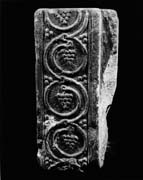
Object type: Architectural feature [1]
Measurements: H. 47 cm (18.5 in); W. 21.5 cm (8.5 in); D. 31 cm (12.25 in)
Stone type: Medium-grained, slightly micaceous, reddish-yellow (7.5YR 6/6) sandstone; deltaic channel sandstone, Saltwick Formation, Aalenian, Middle Jurassic; perhaps from Aislaby, near Whitby (see Fig. 5)
Plate numbers in printed volume: 605-609
Corpus volume reference: Vol 3 p. 171
(There may be more views or larger images available for this item. Click on the thumbnail image to view.)
A: The inner moulding on each side is double, lightly modelled, and very slender. The outer moulding is slightly broader on the left-hand side, and very much broader and flat on the right-hand side, which, in addition, is rebated. Within the panel are three volutes and parts of two more of a finely carved plant-scroll, its organization half-way between simple and spiral forms. A short triangular berry-bunch hangs within each volute, with a small hook tendril on the stalk. The volutes spring from ridged nodes and groups of three detached pellets fill each spandrel. There are no leaf forms.
B: Dressed at top, scabbled below.
C: Roughly dressed.
D: Finely dressed, diagonal tooling. A short vertical incised line runs down from the top of this face.
E (top) and F (bottom): Recut.
This is very likely part of a door jamb with a rebate. Bede speaks of the monastery at Lastingham being rebuilt in stone and this very finely carved detail indicates embellishment of those buildings in the later eighth century.
The plant-scroll is light and delicate, carefully ordered, and, owing to the absence of leaves and the use of pellets in the spandrels, more geometrical than foliate. The nodes have the appearance of hooks and the open spirals contain assertively triangular grape-bunches. The cutting is highly accomplished, even to producing 0.25-in mouldings with absolute sureness.
The scrolls are not as florid as those of York Minster 1 or Hackness 1 and it is rare to find a plant-scroll with such economy of detail arranged with so much space. Perhaps the nearest parallels are in Northumberland: Nunnykirk 1 and Simonburn 1 (Cramp 1984, I, 214–15, II, pl. 208, 1194; ibid., I, 223, pl. 219, 1240) but both are more densely disposed and more sinuously organic. The quality of the present scroll is unique in the area. The reduction of plant forms to geometrical groupings represents an Insular response to introduced Classical elements.
