Volume 4: South-East England
Select a site alphabetically from the choices shown in the box below. Alternatively, browse sculptural examples using the Forward/Back buttons.
Chapters for this volume, along with copies of original in-text images, are available here.
Current Display: Bosham 01, Sussex 

Overview
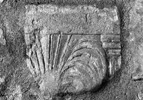
Object type: Fragment
Measurements: H. 30 cm (11.8 in); W. 35 cm (13.8 in); D. Built in
Stone type: Pale yellowish-grey (10YR 8/3–4), finely granular limestone; Caen stone, Calcaire de Caen formation, Bathonian, Middle Jurassic; Caen, Normandy
Plate numbers in printed volume: Ill. 3
Corpus volume reference: Vol 4 p. 125-126
(There may be more views or larger images available for this item. Click on the thumbnail image to view.)
Present Location
Built in to west end of north wall of north aisle, inside
Evidence for Discovery
First recorded by author in 1991
Church Dedication
Holy Trinity
Present Condition
Angles and face bruised, but unweathered
Description
Irregularly broken below and to either side, but with an original upper horizontal edge. Along this edge is a broad plain border, supported to the right by a stepped capital carried by a reeded pilaster, partially broken away. To the extreme left may be the remains of another stepped capital, but the degree of damage renders this uncertain. The remains of the intervening field are decorated with a three-element palmette or foliate spray developing from the lower edge. Each element is reeded.
Discussion
The small size of the fragment makes its original function difficult to establish. The lack of weathering may suggest that it was originally located inside a building, and the use of plant sprays between reeded pilasters is reminiscent of the decorative friezes at Sompting 9–11 (Ills. 172–80) and Dover, St Mary in Castro no. 4 (Ill. 70). The dating of the piece is equally problematic, but the use of reeded, formalized foliage, perhaps derived from acanthus, is paralleled on the string-course fragments from Sompting (nos. 1–8; Ills. 162–71), and a similar mid eleventh-century date is possible for this fragment.
Date
Eleventh century
References
Unpublished
D.T.
Endnotes
