Select a site alphabetically from the choices shown in the box below. Alternatively, browse sculptural examples using the Forward/Back buttons.
Chapters for this volume, along with copies of original in-text images, are available here.


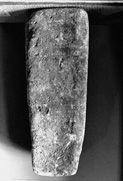
Object type: Grave-marker [1]
Measurements: H. 40.5 cm (15.9 in); W. 15 cm (5.9 in); D. 14.5 cm (5.7 in)
Stone type: Pale greyish-yellow, finely granular limestone, with moulds of shell fragments and (in a cored sample) the foraminifer Alveolina; Calcaire Grossier Formation, Palaeogene, Tertiary; Paris Basin [2]
Plate numbers in printed volume: Ills. 155-157
Corpus volume reference: Vol 4 p. 168-170
(There may be more views or larger images available for this item. Click on the thumbnail image to view.)
Tapering pillar of square section, cut off flat above and rounded below.
A: A pair of incised lines parallels the upper three-fifths of the right-hand edge, and towards the upper end of the vertical axis of the face is a runic inscription, framed by a pair of incised lines running off the upper edge.
Inscription The runes are cut between framing lines, running left to right from the wide end. The stone is soft and the inscription extremely worn. It may be read:
[.]æ∗æ[.]u[.]
No incised lines of the first rune remain. The third, transcribed &lowest;, is formally identical with a Roman N, but could also perhaps be a variant form of runic 's' or 'h'. The fifth rune is clearly 'r' or 'b'. To the right of 'u' is a distinct diagonal line, discussed further below. The final rune is a stave with a roughly worn patch to the right of its top, where there could perhaps have been an arm. This rune could therefore be 'i' or 'l'. The inscription is closed by a faint vertical framing line of quite different character to the other incisions.
B: A pair of incised lines parallels the upper half of the left-hand edge of face B.
C and D: Undecorated.
The two stones from this site are very closely related in form, and must have served the same function. Their use as grave-markers is suggested by the fact that the roughly-tapering bases were evidently inserted in the ground and the upper ends left exposed, as is the case with grave-markers. In addition, if the runic inscription on Sandwich 1 may be interpreted as a personal name, this would again suggest a commemorative function.
Linguistic features may be tentatively interpreted as pointing to a date anywhere between the fifth and eighth centuries (see Parsons below). The absence of Christian symbolism on what are apparently memorial sculptures may point to the earlier part of that period, as may their possible relationship to wooden prototypes, rather than the standard stone sculptural forms of the region. Merovingian funerary monuments of comparable form are also unlikely to date from after the seventh century (Cramp 1993, 70).
Inscription The reading 'ræhæbul', considered to be a personal name, was first proposed by Haigh (Haigh 1861, 52), and supported by Stephens (Stephens 1866–1901, i, 365). Both scholars published drawings which do indeed clearly show the first rune as 'r', the fifth as 'b', the sixth as 'u', with no mark to its right, and the final rune as 'l', the others being as transcribed above. On their evidence the reading is correct, providing that the third rune is read as 'h', and not 's' or N.
As I examine in more detail elsewhere, however, there is considerable reason to doubt the evidence for this reading (Parsons 1994). An earlier drawing than those of Haigh and Stephens (who corresponded and knew each other's work) is found in Thomas Wright's Archaeological Album (Wright 1845, 12). It is the work of the illustrator F. W. Fairholt, whose notebooks survive in the Victoria and Albert Museum. Comparison between the published and unpublished Fairholt drawings shows that, although he worked up his first sketch to give a more 'runic' appearance, each of his series agrees with my reading against that of Haigh and Stephens, in so far as the first rune is not 'r', the fifth is not 'b', the mark to the right of the 'u' bow is clearly shown, and there is no arm on the final stave nor a framing line closing the inscription. In fact, Fairholt's first drawing is closely similar to mine, and suggests that the inscription, already described by Wright as 'much defaced', has deteriorated very little from their day to this.
Wright's evidence is central, but it is supported by two other observations. First, the stone has been in the museum at Canterbury throughout this time, and so considerable wear is unlikely. Second, Haigh's reputation as an accurate scholar is poor, as was his command of philology. When he initially proposed the reading he regarded it as a name 'supported as to both its elements by Rahulf....and Theabul' (Haigh 1861, 52), names that he had found in Anglo-Saxon charters. These forms are indeed evidenced (Sawyer 1968, nos. 19, 21, and 1548), but a combination of Rah- and -abul will not do: the first is probably a spurious parallel (Rahulf is likely to be Raulf, a contracted form of Radulf from a late manuscript), and no etymology can be suggested that would divide The-abul. It is likely, therefore, that 'ræhæbul' simply represents Haigh's best efforts to marry attested names with the fragments that were visible on the stone, efforts which were accepted by the uncritical Stephens and became the authoritative reading.
'ræhæbul' remains a possible reading of the inscription, provided that the line carved to the right of 'u' is regarded as an error. But even with the same proviso it is only one of many permutations allowed by my examination. The first problem is the initial rune. Here the soft stone is heavily worn and I found no trace of incision, but in some photographs (e.g. Elliott 1959 (and idem 1989, pl. X, fig. 27) there are the faintest indications of marks in the space preceding the second rune. If they are not illusory (and Fairholt's first drawing encouragingly shows one of them) they could be consistent with the stave and top part of a rather straight bow of 'r', but they would also allow 'b' and perhaps 'w'; alternatively they might not both belong to a single rune. Taking 'r' or 'b' as most likely adds twenty-three possibilities to 'ræhæbul' (i.e. by combining 'ræhæ-', 'rænæ-', 'ræsæ-', 'bæhæ-', 'bænæ-', 'bæsæ-', with '-rul', '-rui', '-bul', '-bui') and there is no formal means of choosing between them. I can see no straightforward interpretation amongst the combinations. Dickins did manage to justify an etymology for 'ræhæbul' (Dickins 1938, 84), but his suggestions are based wholly on elements not attested in Old English (or Norse) and must be regarded as strained. Moreover, recent work on the etymology of Theabul (Insley 1991, 331) throws considerable doubt on the way in which Dickins uses this as a parallel. So far, possible readings have ignored the diagonal to the right of 'u'. Attention was first drawn to this line, 'sharply incised like the rest of the inscription', and to the insecurity of the traditional reading, by Evison (Evison 1960, 243–4). However, her reinterpretation of this part of the text as 'i' followed by a variant form of 's' is unconvincing, for the bow of what I consider to be 'u' curves very sharply; the fact that it does not join with the stave at the top is readily paralleled and probably insignificant. Nonetheless there could conceivably be a bind-rune with the 'u', as 'u/s', or, if the line belonged to a Scandinavian-looking form of k, as u/k. This last possibility is an attractive one because it gives the only intelligible permutation that I can see: -bu/ki could be the recorded Old Norse personal name element -bogi (for example, Finnbogi, Húnbogi (Lind 1905–15, 269–70, 598)). Accepting this interpretation would call for a series of further comments. First, an inscription running vertically up or down the side of a stone links with early Scandinavian, rather than Anglo-Saxon, practice. None of the clear rune-forms speaks against such a link, and if the third rune were read as 'h' (which remains possible but unprovable) this would speak in its favour, for the Scandinavian h has one cross-bar, in contrast to the usual Anglo-Saxon double-barred form. Second, the interpretation would give some indication of date. buki for bogi uses Viking-age runic orthography, which replaced earlier, more precise, spellings during the seventh and eighth centuries. On the other hand the form and probable value of the second and fourth runes point towards the older system, so a date during the transitional period would suggest itself.
The reading -bu/ki must remain uncertain, however, for the bind-rune is not of a usual type; it is possible that the diagonal to the right of 'u', though intentionally incised, is simply a mistake. Without the reading, the Scandinavian connection is much less persuasive and the arguments for dating no longer valid. Other indications must be proposed very tentatively indeed. If the third rune is read as 'h' then its retention between vowels is an early feature of both Old English and Old Norse. If the text is Old English, æ between name-elements or final i would also point to a relatively early period, probably no later than the eighth century. But it must be stressed that dating on linguistic grounds is a perilous science at the best of times; for the present stone it is not even possible to propose a secure reading of the text.
