Select a site alphabetically from the choices shown in the box below. Alternatively, browse sculptural examples using the Forward/Back buttons.
Chapters for this volume, along with copies of original in-text images, are available here.


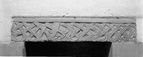
Object type: Part of string-course [1]
Measurements: H. 11.5 cm (4.5 in); W. 59 cm (23 in); D. 26 cm (10.2 in)
Stone type: Pale grey to yellowish, fine-grained, soft limestone; Caen stone, Calcaire de Caen Formation, Bathonian, Middle Jurassic; Caen, Normandy
Plate numbers in printed volume: Ill. 162
Corpus volume reference: Vol 4 p. 173
(There may be more views or larger images available for this item. Click on the thumbnail image to view.)
As with Sompting nos. 2 and 3, it is evident that the border at some stage has been cut back and dressed flat. The same fine claw tooling seen on this secondary working is apparent also on the surface of the carving, and this suggests that it too has been redressed. The close correspondence in size, material and decoration between Sompting nos. 1–3 suggests that they originally formed part of the same feature; Sompting nos. 5–8 may also have come from the same source. The leaf decoration on these fragments does not match nos. 1–3 exactly, but the handling of the leaves is very similar, and again both the size and material of the pieces is the same. The total length of these pieces is 372 cm, and since no stone is complete the original length must have been much greater. Both this great length and the form of the pieces suggests that they have come from a string-course. The lack of weathering indicates that this was internal.
The foliage on the fragments is best paralleled in the borders of late Anglo-Saxon manuscript miniatures, as on fols. 17v and 126v of the Arenberg Gospels of c. 990–1000 (Temple 1976, no. 56, ill. 169). It is encountered also in late Anglo-Saxon metalwork and ivory. Taken together, these parallels suggest an eleventh-century date for the fragments. For further detailed discussion, see Chap. VII.
