Select a site alphabetically from the choices shown in the box below. Alternatively, browse sculptural examples using the Forward/Back buttons.
Chapters for this volume, along with copies of original in-text images, are available here.


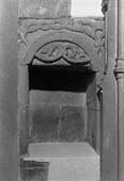
Object type: Frieze or blind arcade fragment [1]
Measurements: H. 26 (10.2 in); W. c. 53 cm (21 in); D. 6 cm (2.4 in)
Stone type: Pale yellowish-grey, fine-grained, pelletal limestone; Caen stone, Calcaire de Caen Formation, Bathonian, Middle Jurassic; Caen, Normandy [2]
Plate numbers in printed volume: Ills. 172-174
Corpus volume reference: Vol 4 p. 175-176
(There may be more views or larger images available for this item. Click on the thumbnail image to view.)
It is evident that this fragment and Sompting nos. 10 and 11 all derive from the same feature. As the remains of five arch heads survive, this feature must originally have been more than 500 cm in length. Close examination of the pieces reveals that the junctions of the arch heads were originally carried down to form piers. Moreover, in each case the careful confinement of the plant ornament to the tympanum suggests that it did not extend down between each pair of piers. Instead the piers must have flanked niches, or possibly separate sculptured panels. The fragments must, therefore, be reconstructed as either a frieze or blind arcade. Alternatively, the pieces may have formed part of a free-standing screen. This, perhaps, is less likely as Sompting no. 11 has the arch carved only on the lower half of a larger stone, the upper part of which is only roughly dressed. If this were a frieze or blind arcade then the upper part could have been plastered, but if the fragments formed part of a screen it is difficult to see how this could have been disguised, particularly as the other fragments lack such a feature.
As with the string-course fragments Sompting nos. 1–8, the best parallels for the form of the arch heads and their decoration are provided by late pre-Conquest manuscripts, notably the Trinity Gospels, dated to the second quarter of the eleventh century (Temple 1976, no. 65), and Warsaw, Bibl. Narodowa MS I. 3311, dated to about the year 1000 (ibid., no. 92, figs. 51–5, ills. 281–4). For further discussion see also Chap. VII.
